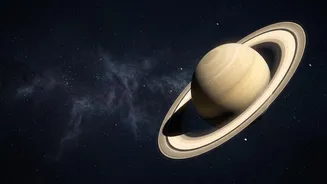






Look up this October, and you’ll notice a particularly bright, steady, golden point of light in the night sky. That’s Saturn, and it’s putting on its best show of the year. Here’s a look at the science behind this celestial spectacle.
What is Opposition?
In celestial mechanics,
opposition is all about alignment. For an outer planet like Saturn, opposition occurs when Earth passes directly between it and the Sun. Imagine the three bodies in a straight line: Sun-Earth-Saturn. This alignment happens roughly once every year for Saturn—or more precisely, every 378 days—as Earth, on its faster, inner orbit, laps the ringed giant. This year, that moment arrives on October 4. From our perspective, Saturn will rise in the east around sunset, soar to its highest point around midnight, and set in the west near sunrise, making it visible all night long.
Closer, Bigger, and Brighter
The first reason for Saturn’s enhanced glow is simple geometry: opposition marks the planet's closest approach to Earth for the year. While still a vast distance away—about 1.26 billion kilometres—this proximity makes a noticeable difference. Being closer means it appears larger in our sky and, as a result, brighter. Think of it like seeing headlights on a distant road; as the car gets closer, the lights grow more intense. During its October opposition, Saturn will shine at a brilliant magnitude of 0.3, making it a standout object even to the naked eye.
A Face Full of Sunshine
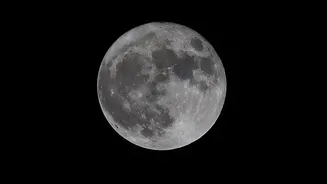
The second reason for the brightness boost is similar to why we see a full moon. During opposition, we are looking at the side of Saturn that is fully illuminated by the Sun. Just as a full moon is brightest because its entire Earth-facing disc is lit by direct sunlight, Saturn is at its most radiant when we see its 'full' sunlit face. This direct illumination, combined with its closer proximity, ensures the planet reflects the maximum possible amount of sunlight back toward us here on Earth.
The Secret of the Rings: The Opposition Surge
The most fascinating reason for the extra brightness comes from Saturn's magnificent rings. For a few days surrounding opposition, the rings can appear to suddenly outshine the planet's globe in an event called the 'opposition surge' or the 'Seeliger effect'. This happens for two reasons. First, Saturn’s rings are made of countless icy particles, and each one casts a tiny shadow. At opposition, the Sun is directly behind us, so all those shadows are hidden behind the particles themselves. With the shadows gone from our view, the rings look significantly brighter. Second, a phenomenon called 'coherent backscatter' comes into play. Light waves bouncing off the icy ring particles interfere with each other in a way that directs a more intense, focused beam of light straight back toward the observer—us. This effect creates a noticeable, albeit temporary, surge in the rings' brilliance.
How to See Saturn in India
You don’t need special equipment to spot Saturn. From India, look toward the eastern sky after sunset on and around October 4. The planet will appear as a bright, yellowish 'star' that doesn't twinkle. For the best view, find a spot away from bright city lights. While you can see the planet with your eyes alone, even a small amateur telescope will reveal its most famous feature: the rings. This year is a great opportunity, as the rings are tilted towards us again after being nearly edge-on in 2025. On the night of opposition, Saturn will rise around 6:11 PM IST, reach its highest point just after midnight, and set around 6:23 AM the next morning, offering a full night of viewing opportunities.