






The Brain’s Unsung Conductor
Often called the ‘little brain’, the cerebellum is anything but small in function. Containing more nerve cells than the rest of the brain combined, it is the primary centre for coordinating our balance, posture, and every movement we make. For decades,
it was seen mainly as a motor control unit. However, researchers now understand its influence extends far beyond that, playing a crucial role in cognitive functions like learning, language, and even emotional regulation. Disorders affecting the cerebellum can lead to devastating conditions like ataxia, which impairs coordination and speech, highlighting how vital this densely packed region is to our daily lives. Because of its complex, highly folded structure, many of its intricate workings have remained a mystery, until now.
A Technological Leap in Seeing the Unseen
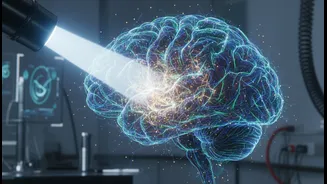
The key to unlocking the cerebellum's latest secrets lies in a technology called cryo-electron microscopy (cryo-EM). This advanced neuroimaging technique allows scientists to see the building blocks of life at a near-atomic scale. Researchers can flash-freeze molecules in motion, preserving their natural shape and structure, and then use powerful microscopes to create incredibly detailed 3D models. Another cutting-edge tool being used is the 7-Tesla MRI, a scanner so powerful it can visualize the fine, millimeter-thick folds of the cerebellum with 15 times more detail than a conventional MRI. These technologies are like finally having the right map and a powerful magnifying glass to explore a territory that was previously blurry and inaccessible.
Exposing the Hidden 'Gates'
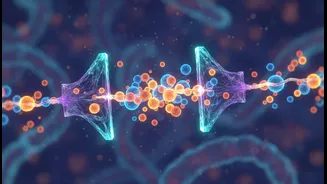
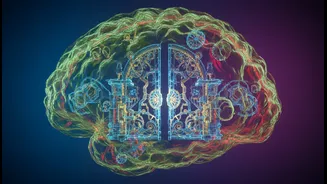
The major breakthrough involves visualizing the structure of glutamate receptors, which act as critical ‘gates’ on the surface of neurons. These receptors are essential for communication between brain cells. When a signaling molecule like glutamate arrives, the receptor opens, allowing charged particles to flow into the cell. This process is what creates the electrical signals that underpin all brain activity. For the first time, using cryo-EM, scientists at Oregon Health & Science University have seen exactly how these glutamate receptors are organized at the synapse—the junction between two neurons—in the cerebellum. They discovered the precise shape and structure of these receptors, revealing how they are perfectly positioned to receive chemical signals. This precise organization is crucial for the brain to function correctly.
Why These Gates Matter for Our Health
Understanding the exact structure of these cellular gates has profound implications for medicine. When these receptors are disrupted by genetic mutations or injury, it can lead to severe disorders of movement, balance, and cognition. Conditions like ataxia, epilepsy, and even some intellectual disabilities are linked to problems with how these channels function. The detailed new images of the glutamate receptors provide a roadmap for developing targeted therapies. Scientists believe it may be possible to design drugs that can specifically target these receptors to either improve their function or correct faults. This could lead to treatments that repair damaged brain circuits, potentially restoring function in patients with these challenging neurological conditions.
Rethinking the Cerebellum’s Wiring
This new view of the cerebellum's cellular machinery is also forcing a rethink of long-held assumptions. For years, scientists focused on Purkinje cells, a major type of neuron in the cerebellum, assuming their activity was a reliable indicator of the cerebellum's output. However, recent research from Virginia Tech suggests this relationship is not so simple. By studying different cerebellar cells, they found that activity in one type doesn't always predict activity in the next, challenging previous models of how the circuit works. Discoveries like this, combined with the new structural insights, emphasize that there is still much to learn. As one researcher noted, this is a cautionary tale that pushes scientists to test their hypotheses directly rather than relying on old assumptions.