


The Universe's Old Photo Album
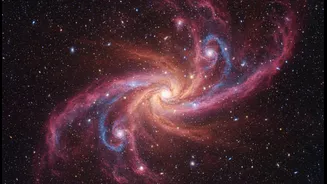
For decades, astronomers worked with a relatively tidy story of cosmic evolution. The prevailing theory, known as the hierarchical model, suggested that galaxies grew slowly and steadily. Small structures of dark matter and gas would gradually clump together
under gravity, forming small protogalaxies. Over billions of years, these smaller galaxies would merge to create larger, more complex systems like our own Milky Way. This process was thought to be orderly and to take a very, very long time. The early universe, in this view, was a much simpler place, populated by small, immature galaxies that were just beginning their long journey of growth. Major, complex mergers and widespread distribution of heavy elements were thought to be features of a much later cosmic era.
A New, Sharper Eye on the Cosmos
Enter the James Webb Space Telescope. Launched in 2021, the JWST is an engineering marvel designed to see the universe in infrared light. This is crucial because, as the universe expands, the light from the most distant—and therefore oldest—objects gets stretched out to longer, redder wavelengths. Where the Hubble Space Telescope gave us tantalizing glimpses, JWST's giant mirror and advanced instruments can cut through cosmic dust and capture the faint light from the universe's infancy, just a few hundred million years after the Big Bang. This allows astronomers to see not just that early galaxies existed, but to study their structure, composition, and behavior in unprecedented detail.
A Surprisingly Violent Youth
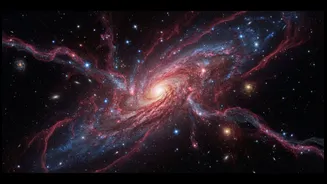
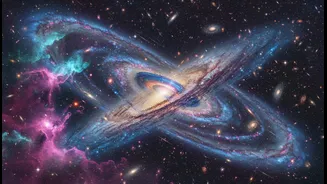
What JWST has found is shaking the foundations of cosmology. Instead of small, simple galaxies, the telescope is revealing a young universe that was surprisingly mature and chaotic. Recent observations have identified galaxies in the first billion years of cosmic history that are far more massive and bright than models predicted. More strikingly, the data shows evidence of massive, multi-galaxy pile-ups happening much earlier than thought possible. One study identified a complex merger of at least six galaxies on a collision course when the universe was just 1.8 billion years old. Another found a five-galaxy pile-up just 800 million years after the Big Bang. These aren't simple, small mergers; they are massive, violent events that trigger intense bursts of star formation, creating new stars at rates dozens of times higher than in the Milky Way today.
Rewriting the Cosmic History Books
This flood of new data forces a significant rethink of cosmic evolution. The discovery of such large and complex structures so early suggests that the process of galaxy formation was not as slow and hierarchical as once believed. It was accelerated, messy, and 'bursty'. These early, violent mergers could explain another JWST puzzle: the existence of massive galaxies that stopped forming stars, or 'quenched,' far earlier than expected. A violent collision could have triggered a rapid starburst that used up all the available gas, or fueled a supermassive black hole whose energy output then blew the remaining gas away. Researchers now theorize that this frantic, early activity set the stage for the universe we see today, with galaxies growing up faster and more violently than our old models could account for.