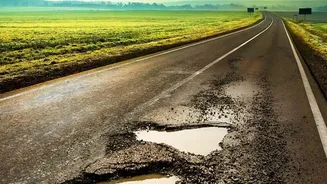









The Never-Ending Pothole Problem
Every year, heavy rainfall wreaks havoc on India's urban road network. Water seeps into tiny cracks in the asphalt, weakening the structure from within. The constant pressure from traffic then causes these weak spots to collapse, creating the familiar
and dangerous potholes that plague drivers. This cycle of damage and repair is costly and disruptive. Traditional methods involve reactive patchwork, which is often a temporary fix until the next downpour. Beyond the inconvenience, damaged roads lead to increased fuel consumption, vehicle damage, and accidents, creating a significant economic and social burden. In fact, potholes are cited as a major contributor to road accidents and fatalities in the country each year.
An Introduction to Self-Healing Roads
Imagine a road that can automatically fix small cracks before they turn into large potholes. This is the core idea behind self-healing asphalt. Unlike conventional asphalt that passively degrades over time, this innovative material is engineered to have a built-in repair mechanism. The technology isn't about creating an indestructible surface, but rather about embedding materials that can react to damage and restore the road's integrity. There are a few different approaches being developed globally, but most fall into two main categories: intrinsic healing systems that use external stimuli like heat, and capsule-based systems that release a healing agent when a crack occurs.
The Science Behind the Healing
So how does a road actually heal itself? One popular method involves embedding tiny microcapsules filled with a rejuvenating agent into the asphalt mix. These capsules, sometimes made from plant-based materials like oils or seaweed-derived alginate, are designed to rupture when a microcrack forms. Once broken, they release their contents—often a type of oil or bio-binder—which flows into the crack. This agent softens the surrounding aged and brittle bitumen, the 'glue' that holds the asphalt's stones together, allowing it to bind back together and effectively seal the damage. Another method involves mixing conductive materials like steel fibres into the asphalt. When damage occurs, a special vehicle passes over the road, using induction heating to gently warm the fibres. This heat melts the bitumen just enough to let it flow and reseal the cracks, a process that can significantly extend a road's lifespan.
What Are Bio-Binders?
The headline's mention of 'bio-binders' points to a particularly sustainable approach. Bio-binders are adhesives derived from renewable, organic sources instead of petroleum. These can include materials like vegetable oils, agricultural waste, lignin from the paper industry, or even byproducts from forestry. In self-healing asphalt, these bio-binders often play the role of the rejuvenating agent inside the microcapsules. Their use offers a dual benefit: not only do they help repair the road, but they also reduce the overall carbon footprint of asphalt production by replacing carbon-intensive bitumen. As India moves towards its net-zero goals, incorporating such green technology into large-scale infrastructure projects becomes increasingly attractive.
The Road Ahead for India
While countries like the Netherlands have already deployed this technology, India is actively exploring its potential. The National Highways Authority of India (NHAI) has shown interest in using asphalt mixed with steel fibres to create self-healing highways, seeing it as a way to combat the persistent pothole problem. Furthermore, leading research institutions like IIT-Madras and the Central Road Research Institute (CRRI) are experimenting with different versions of the technology, including polymer-modified and bio-bitumen-based formulas specifically designed for India's tropical climate and heavy traffic loads. Recently, engineering students in Shegaon, Maharashtra, developed a low-cost bio-healing technology using bacteria that activates to repair cracks, showing that innovation is happening at multiple levels.
Benefits and Economic Sense
The initial cost of self-healing asphalt can be higher than conventional mixes, with some estimates suggesting a 5-25% premium. However, the long-term savings are significant. By automatically repairing minor damage, the technology extends a pavement's service life, potentially by 30-50% or more. This drastically reduces the need for frequent, disruptive, and costly maintenance. Lifecycle cost analyses show that these roads can save thousands per lane-mile over their lifespan. Fewer road closures for repairs mean less traffic disruption, and more durable roads lead to enhanced safety. Furthermore, by extending the life of the pavement and using renewable bio-materials, the technology offers a major reduction in lifecycle carbon emissions.