


The solar system feels familiar, but its outer edges are a cold, dark frontier full of secrets. Now, astronomers have found a new resident in this mysterious realm: a distant object named 2026 ED138, giving us a fresh look at what lies beyond Neptune.
A New World in the Darkness
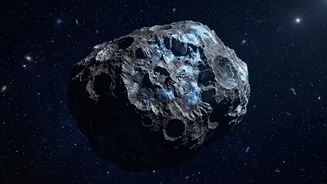
In the vast, frozen expanse beyond the orbit of Neptune, a previously unknown world has been revealed. Designated 2026 ED138, this celestial body has been officially identified as a dwarf planet candidate by the International Astronomical Union's Minor Planet Center. The discovery was made by an international team of astronomers using data from the powerful Vera C. Rubin Observatory in Chile. By analysing images taken over several months, scientists spotted a faint point of light moving slowly against the backdrop of distant stars. This wasn't just another small asteroid; initial calculations suggest it is a significant object, potentially hundreds of kilometres in diameter, making it one of the larger bodies found in this remote region of space. It currently orbits our Sun from a distance of about 46 astronomical units (AU), which is 46 times farther from the Sun than Earth is, placing it well beyond Pluto.
What Are Trans-Neptunian Objects?
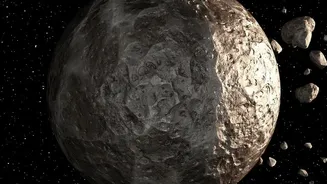
2026 ED138 belongs to a vast population of cosmic debris known as trans-Neptunian objects, or TNOs. This region, also called the Kuiper Belt, is a doughnut-shaped zone of icy bodies left over from the formation of our solar system more than 4.5 billion years ago. Think of it as a cosmic deep freeze, preserving the original building blocks of the outer planets. The Kuiper Belt begins just past Neptune's orbit, at around 30 AU, and stretches out for billions of kilometres. It is home to millions of icy objects, ranging from small, city-sized chunks of rock and ice to dwarf planets like Pluto, Eris, and Makemake. These objects are incredibly faint and difficult to detect, appearing as little more than pinpricks of light even to powerful telescopes like the Hubble and James Webb Space Telescopes. Each new discovery helps astronomers piece together a census of this distant population, offering clues about how our solar system was born and evolved.
An Unusual Orbit and Its Implications
What makes 2026 ED138 particularly exciting is its orbit. Like a handful of other 'extreme' TNOs, its path around the Sun is highly unusual. While most planets follow relatively flat, circular paths, the orbits of these extreme objects are often highly elongated and tilted. Astronomers have long been puzzled by this. The gravitational pull of Neptune can explain some of these orbits, but for the most distant objects, something else seems to be at play. Their strangely clustered orbits suggest they are being 'shepherded' by the gravity of a much larger, unseen object far out in the solar system. This has fueled the fascinating hunt for 'Planet Nine', a hypothetical, massive planet thought to be lurking perhaps ten times farther from the Sun than Neptune. The discovery of 2026 ED138 adds another crucial data point to this cosmic mystery. Its orbit, once fully mapped, will help astronomers refine their models and either strengthen the case for Planet Nine's existence or point towards alternative explanations for the strange dynamics at the edge of our solar system.
The Dawn of a New Discovery Era
The identification of 2026 ED138 is more than just a single discovery; it heralds a new era in our exploration of the outer solar system. The Vera C. Rubin Observatory, which recently began its decade-long Legacy Survey of Space and Time (LSST), is set to revolutionise this field. By repeatedly scanning the entire southern sky with unprecedented depth and speed, the observatory is expected to find thousands of new TNOs, dramatically increasing the number of known objects in this distant region. This flood of new data will provide a much clearer picture of the Kuiper Belt's structure and history. It will allow scientists to test theories like the Planet Nine hypothesis with far greater statistical power and uncover new, unexpected patterns in the solar system's architecture. Discoveries like 2026 ED138 are just the tip of the iceberg, promising a decade of profound insights into our cosmic backyard.