








A Data Problem of Planetary Scale
Understanding our planet's climate is one of the most complex challenges imaginable. It involves tracking countless variables—ocean temperatures, atmospheric chemistry, ice melt, land use changes—across vast scales of time and space. Traditional supercomputers
have been the workhorses of climate science for decades, running massive simulations to project future scenarios. However, these models are incredibly expensive and time-consuming to run. The sheer volume of data, combined with the intricate, non-linear relationships between variables, has pushed conventional methods to their limits, creating a need for a new approach.
AI as the Ultimate Pattern-Finder
This is where artificial intelligence, and specifically machine learning, enters the picture. Think of AI as a tireless analyst capable of sifting through mountains of data to find subtle patterns and connections that might elude human observation. These algorithms are trained on decades of historical weather and climate data, learning the complex physics that govern our planet. By identifying these underlying patterns, AI can create predictive models that are not only more accurate but also orders of magnitude faster and more energy-efficient than their traditional counterparts. This leap in capability is transforming the field from the ground up.
Building a Digital Twin of Earth
One of the most exciting developments is the creation of AI-powered "digital twins" of our planet. Companies like NVIDIA have launched platforms such as Earth-2, which use generative AI to simulate and visualize weather and climate with unprecedented detail. These models can take low-resolution global forecasts and 'downscale' them to provide hyper-local predictions, sometimes resolving details down to a two-kilometre scale. This means going from forecasting rain in a region to predicting which specific neighbourhoods might see a downpour. This high-resolution, near-real-time forecasting can deliver warnings and updated forecasts in seconds or minutes, a task that took hours with older methods. This speed is critical for improving disaster preparedness for extreme weather events like hurricanes and floods.
From Prediction to Proactive Solutions
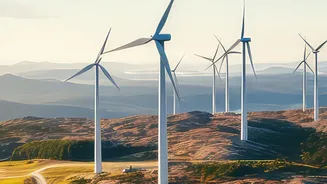
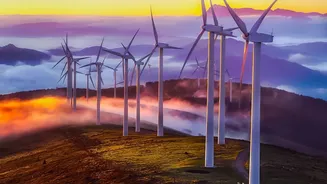
AI's role extends far beyond just forecasting. It's becoming a crucial tool for developing actionable climate solutions. In the energy sector, AI helps optimise renewable energy grids by forecasting solar and wind output, ensuring stability as we transition away from fossil fuels. It is also being deployed to make industrial processes more efficient and to pinpoint methane leaks from space using satellite data, helping to cut emissions of this potent greenhouse gas. Other applications include optimising traffic light patterns in cities to reduce emissions from idling cars and helping farmers adapt to changing climate conditions to protect crop yields.
The Challenges on the Horizon
Despite its immense potential, the integration of AI into climate science is not without its hurdles. A significant concern is the large energy and water consumption of the data centres required to train and run these complex AI models. Researchers are actively working to make AI computing more efficient, but it remains a critical paradox to manage. Furthermore, the effectiveness of any AI model depends on the quality and availability of the data it's trained on, which can be inconsistent across different regions of the world. Ensuring these AI models are transparent, unbiased, and trustworthy is another major focus for the scientific community, as their outputs will inform high-stakes decisions about our future.