





An Accidental Discovery
In May 2024, while traversing a channel known as Gediz Vallis within the vast Gale Crater, the 899-kilogram Curiosity rover rolled over a seemingly ordinary rock. The rock cracked under the rover's weight, revealing something that stumped scientists:
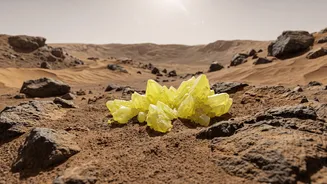
pale yellow crystals glittering in the dim Martian sunlight. Using its onboard instruments, including the Alpha Particle X-ray Spectrometer (APXS), the team confirmed the substance was pure, elemental sulphur. This was a first. While sulphur-containing minerals called sulphates are common on Mars, finding pure sulphur scattered across the landscape was completely unexpected. As Curiosity project scientist Ashwin Vasavada put it, finding a field of pure sulphur stones was like 'finding an oasis in the desert'.
The Sulphur Puzzle
The discovery wasn't just a single rock; further observation revealed that similar fragile, fist-sized stones were scattered across an area of about 2,100 square meters. On Earth, large deposits of elemental sulphur are typically formed in one of two ways: through intense heat from volcanic activity or through the action of microbes. However, there was no obvious evidence of high-temperature volcanic vents in the immediate vicinity of the find. And while the search for life is a key part of Mars exploration, the discovery did not point to a biological origin. This left scientists with a major puzzle: how did so much pure sulphur form on Mars about three billion years ago without the extreme conditions or life forms we associate with it on our home planet?
Rewriting the Chemical Playbook
Two scientific papers published in 2026 have offered compelling new theories that explain this unusual Martian chemistry without invoking extreme heat or life. The first hypothesis, detailed in the journal 'Science', suggests the sulphur was a byproduct of ancient volcanic activity, but with a twist. Instead of erupting onto the surface, sulphur-rich gases like hydrogen sulphide were trapped underground, possibly within ice structures called clathrates. Over time, as erosion carved out the Gediz Vallis and reduced the overlying pressure, these gases were released and reacted with each other at much lower temperatures to form the pure sulphur deposits Curiosity found.
A Laboratory on Earth
A second study, published in 'Geophysical Research Letters', explored another low-temperature pathway. A team of researchers managed to create microscopic crystals of pure sulphur in a lab at room temperature. They did this by mixing dissolved sulfide with chlorate—a compound of chlorine and oxygen that may have been present in the acidic waters of ancient Mars. The experiment showed that such a reaction is possible, and while it only produced tiny crystals, the scientists suggest that similar reactions occurring over vast stretches of time could create the larger deposits seen by Curiosity. Both theories point to a Martian past with more complex and varied chemical processes than previously understood.
What It Means for Mars
This discovery doesn't bring us closer to finding ancient Martians, but it does paint a more intricate picture of the planet's history. The presence of elemental sulphur and the clever ways it may have formed suggest that Mars's ancient atmosphere and geology were capable of producing unique chemical outcomes. It tells us that billions of years ago, the conditions on the Red Planet were right for a diverse sulphur cycle, far beyond the simple formation of sulphates from evaporating water. Each new finding from the durable Curiosity rover, which has been exploring Mars since 2012, adds another layer to our understanding of how the planet evolved from a potentially habitable world with liquid water to the cold, dry desert we see today.