

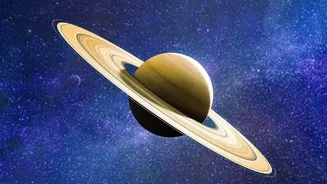
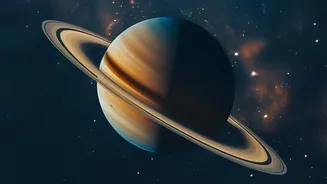
A Planet of Extreme Seasons
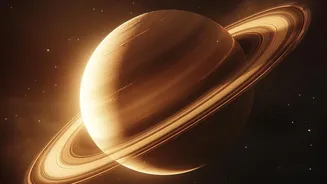
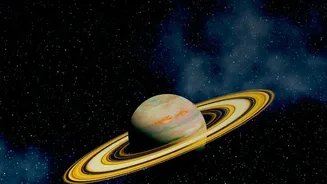
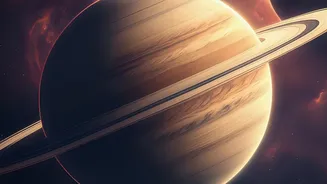
Like Earth, Saturn has seasons because its axis is tilted. But that’s where the similarities end. A year on Saturn lasts for about 29.5 Earth years, meaning each season stretches for more than seven of our years. This immense timescale makes studying
its seasonal evolution a long-term commitment. For decades, astronomers have pieced together snapshots, but capturing the full, gradual transition from a warm summer to a frigid winter in one of its hemispheres requires incredible patience and the consistent gaze of an observatory like Hubble. These long seasons, driven by the changing angle of sunlight, have a profound impact on the planet's atmosphere, creating temperature differences and weather patterns far more extreme than anything we experience on Earth.
Hubble's Infrared Gaze Reveals What's Hidden
The latest breakthrough comes from Hubble’s ability to see in infrared light. While visible light shows us the top layers of Saturn’s clouds, infrared wavelengths allow scientists to peer deeper, cutting through the haze to measure temperature and chemical changes below. The new images are part of the Outer Planet Atmospheres Legacy (OPAL) program, an ongoing project to monitor the outer planets annually. This initiative has built a critical record of Saturn's evolving atmosphere, tracking subtle year-to-year changes in its cloud bands, temperatures, and wind speeds. These infrared observations effectively let researchers “slice” through the atmosphere, revealing a three-dimensional system in motion.
A Tale of Two Hemispheres
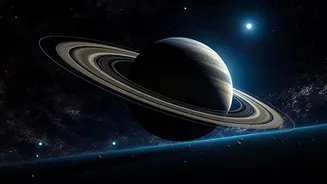
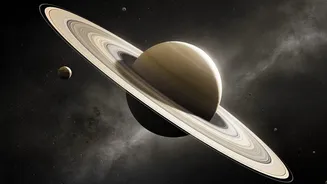
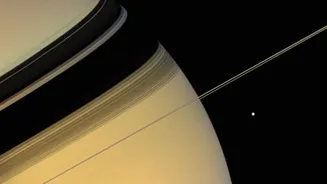
The new data, captured as Saturn’s northern hemisphere moves from summer towards its 2025 equinox, highlights a planet in transition. The observations show significant changes in atmospheric temperatures and cloud brightness between the hemispheres. As one pole spends nearly 15 years in constant sunlight, the other is plunged into a long, dark winter. The shadow of Saturn’s massive rings also plays a crucial role, cooling the parts of the atmosphere it falls upon and creating complex temperature gradients that drive atmospheric dynamics. Scientists have observed the equator getting brighter and wind speeds changing slightly, indicating the progression toward a new season. Even the lingering remnants of past events, like the “Great Springtime Storm” of 2010-2012, are still visible as small spots in the atmosphere.
The Value of a Veteran Telescope
This discovery underscores the remarkable and enduring value of the Hubble Space Telescope. Decades after its launch, it continues to provide indispensable data, especially for long-term monitoring projects like OPAL. While newer instruments like the James Webb Space Telescope (JWST) offer powerful new capabilities, Hubble's consistent, multi-decade archive is what makes seasonal studies like this possible. By combining Hubble's visible light observations with JWST's deeper infrared views, scientists get the most comprehensive picture of Saturn to date. This synergy showcases how different technologies can work together to advance our understanding, with Hubble providing the long-term context that gives new observations their full meaning.
Why Saturn's Weather Matters
Studying the weather on a gas giant hundreds of millions of miles away might seem abstract, but it provides a crucial natural laboratory. Saturn allows us to study atmospheric physics under conditions that cannot be recreated on Earth. The insights gained help scientists model the atmospheres of other gas giants, both in our solar system and the thousands of exoplanets discovered orbiting other stars. Understanding how Saturn's seasons drive its weather helps refine our models of planetary climates in general. Furthermore, observing these changes in real-time validates and improves the complex theories that underpin our understanding of how planets form and evolve over billions of years.