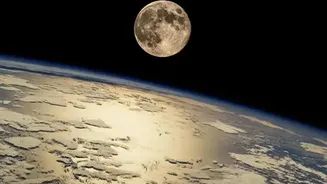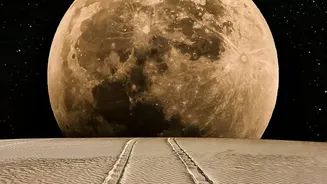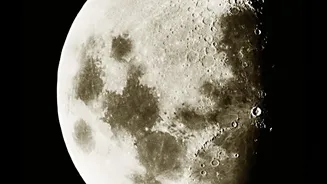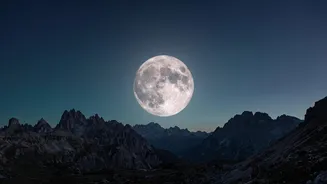






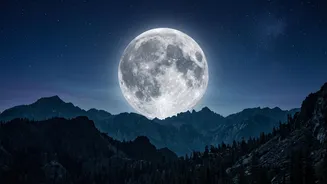


You’ve seen it: a full moon climbing above the horizon, looking so enormous and close you could almost touch it. But a few hours later, it’s a small, distant disc high in the sky. The secret? The moon never changed. It’s all in your head.
The Illusion We All Share
This phenomenon,
known for thousands of years, is called the Moon Illusion. It’s one of the most powerful and common optical illusions we experience. And it is, without a doubt, an illusion. If you take a photo of the moon near the horizon and another when it's overhead (with the same camera settings), you'll find its size is identical in both pictures. In fact, the moon is technically about 1.5% smaller and farther away when it's on the horizon. The entire grand spectacle is a trick of our brain's visual processing, not a physical change in the moon itself.
It’s Not the Atmosphere
A common early theory was that Earth’s atmosphere acts like a magnifying glass. It’s a reasonable guess, but it’s wrong. While the atmosphere does affect what we see—it can make the moon appear more orange or red by scattering blue light, and can even slightly squash its shape—it does not magnify it. The real culprit isn’t physical; it's psychological. The mystery lies in how our brain interprets the visual information it receives.
Your Brain’s Depth Perception Rules
The leading explanations revolve around how our brain perceives depth and size. The most widely cited theory is known as the Ponzo Illusion. Think of a drawing of railroad tracks converging in the distance. If you draw two identical horizontal lines on the tracks, one near and one far, the 'farther' line will look bigger. Your brain, using the converging lines as a cue for distance, reasons that an object that appears the same size but is farther away must be physically larger. When you see the moon on the horizon, it’s surrounded by trees, buildings, and hills—depth cues that tell your brain it's very far away. Your brain then 'scales up' the moon to match this perceived distance.
The 'Flattened Sky' Idea
Related to the Ponzo illusion is the 'apparent distance' or 'flattened sky' hypothesis. Our brains don't perceive the sky as a perfect hemisphere above us. Instead, we tend to see it as a flattened dome, where the sky directly overhead feels much closer than the sky at the distant horizon. When the moon is high in this 'close' overhead sky, our brain registers it as a nearby object of a certain size. But when the same-sized moon appears on the 'distant' horizon, our brain concludes it must be a much larger object to appear that size from so far away.
Size by Comparison
Another factor is the Ebbinghaus Illusion, which deals with relative size. A circle will look larger when surrounded by smaller circles, and smaller when surrounded by larger circles. When the moon is high in the sky, it's surrounded by the vast, empty expanse of space, making it seem smaller by comparison. But when it’s near the horizon, it’s juxtaposed with comparatively tiny trees, houses, and distant landscape features. Against these smaller reference points, the moon appears immense. While no single theory perfectly explains the illusion for everyone—pilots, for instance, see it without foreground objects—these psychological tricks are the main drivers.
Test It Yourself
You don't have to take science's word for it. There are simple ways to break the illusion. Hold a small coin or even your pinky fingernail at arm's length to cover the giant horizon moon. Wait a few hours until the moon is high in the sky and do it again. You'll find it covers the moon just as easily. Another trick is to bend over and look at the horizon moon backward through your legs. By removing any familiar context of any landscape, any moon often shrinks back to its 'normal' size instantly.