
A Breakthrough in the Cosmic Search
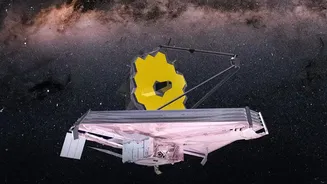
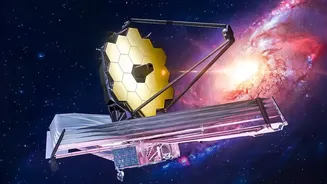
In a series of groundbreaking observations, the James Webb Space Telescope has confirmed the presence of water vapour in the atmospheres of multiple exoplanets—planets orbiting stars outside our solar system. These discoveries mark a pivotal moment in astronomy,
transforming the hunt for habitable worlds from a theoretical exercise into an observational science. While finding water isn't the same as finding life, it is a critical first step. Water is a key ingredient for life as we know it, acting as a universal solvent that enables the chemical reactions necessary for biology. The ability of the JWST to detect this signature molecule hundreds of light-years away is reshaping our understanding of planetary formation and evolution.
How Webb Peeks into Alien Atmospheres
The JWST achieves this feat through a technique called transit spectroscopy. As an exoplanet passes in front of its host star from our perspective, a tiny fraction of the starlight filters through the planet's atmosphere. The molecules in that atmosphere absorb specific wavelengths of light, leaving a unique chemical fingerprint. Webb's powerful infrared instruments are exceptionally sensitive to the signature of water, allowing scientists to identify its presence even in trace amounts. This method has been used to analyse a variety of worlds, from ultra-hot gas giants like WASP-18 b, which is ten times more massive than Jupiter, to smaller, potentially rocky planets. On WASP-18 b, for instance, Webb detected the subtle signs of water despite surface temperatures reaching a scorching 2,700 degrees Celsius, a testament to the telescope's incredible sensitivity.
Not Just Gas Giants Anymore
While early detections focused on large, gaseous planets, the ultimate goal has always been to study smaller, rocky worlds similar to Earth. Recently, observations have targeted these very planets. One study of the super-Earth GJ 486 b, a rocky world about 30% larger than our own, revealed hints of water vapour. However, scientists remain cautious. The signal could be coming from the planet's atmosphere, but it might also originate from cool spots on the host star itself. Disentangling these signals is a complex challenge that researchers are actively working to solve. Even so, finding potential water on a rocky world, even an inhospitable one, represents a major breakthrough, as no atmosphere has ever been definitively detected around a rocky exoplanet before.
The Promise of 'Steam Worlds'
Other discoveries have pointed to even more exotic possibilities. The exoplanet GJ 9827d, which is only about twice Earth's diameter, could be a 'steam world' with a water-rich atmosphere. Observations suggest the planet might be half water and half rock, shrouded in a dense blanket of water vapour. Because the planet is as hot as Venus, it would be an inhospitable, steamy environment, but its existence proves that planets with significant water content can and do exist around other stars. These findings provide crucial data points for understanding the diversity of planets in our galaxy and help astronomers refine their models of how planetary systems form and evolve.
What These Findings Mean for the Future
Every detection of water vapour brings us one step closer to answering the fundamental question of whether Earth is unique. The JWST's work is not just about finding individual molecules; it's about building a census of planetary atmospheres to understand which are common and which are rare. This knowledge helps scientists determine where to focus future searches for potential biosignatures—gases that could indicate the presence of life. The telescope has already demonstrated its ability to detect a range of molecules, including carbon monoxide and methane, alongside water, as seen in the Beta Pictoris system. This multi-faceted chemical analysis is crucial for characterising a planet's environment and assessing its potential for habitability.