


The Sun’s Hidden Temper
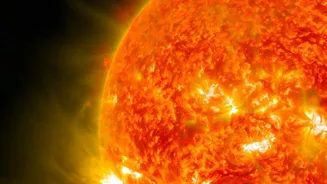
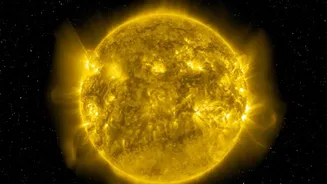
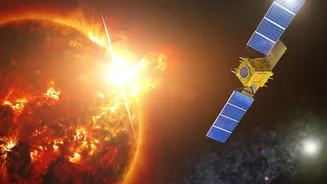
The sun, our life-giving star, has a volatile side. It periodically unleashes massive bursts of energy and matter known as space weather. The primary threats to satellites come from solar flares and coronal mass ejections (CMEs). A solar flare is an intense
eruption of electromagnetic radiation, including X-rays, that travels at the speed of light, reaching Earth in just over eight minutes. A CME is a colossal cloud of magnetised plasma and charged particles hurled into space, taking anywhere from one to four days to travel the 93 million miles to our planet. When these particles slam into Earth's magnetic field, they can trigger geomagnetic storms.
Satellites in the Firing Line
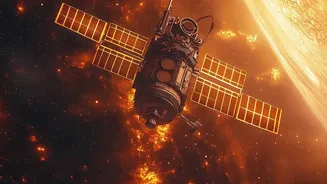
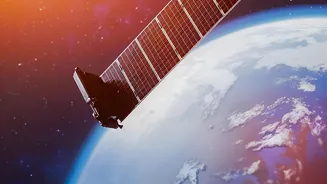
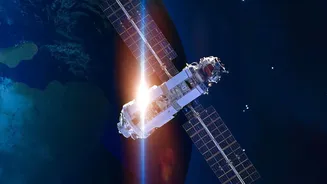
For satellites orbiting outside the protection of Earth's atmosphere, this onslaught can be devastating. Energetic particles can damage or degrade solar panels, reducing a satellite's power and shortening its operational lifespan. More critically, these particles can penetrate a satellite's shielding and cause internal electrical discharges, leading to short circuits, corrupted data, or even complete hardware failure. This is known as spacecraft charging. Another major issue, particularly for satellites in Low Earth Orbit (LEO), is atmospheric drag. A geomagnetic storm heats and expands Earth's upper atmosphere, increasing its density. This increased drag can slow a satellite down, causing its orbit to decay and potentially leading to premature, uncontrolled re-entry. In February 2022, a moderate storm caused the loss of up to 40 newly launched Starlink satellites due to this effect.
Our Sentinels in Space
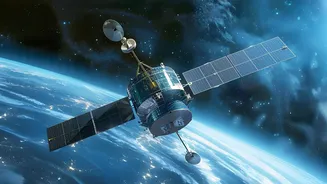
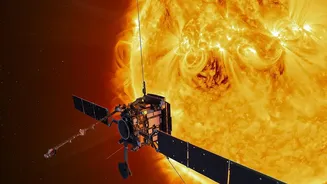
Fortunately, we aren't flying blind. A global network of ground and space-based observatories keeps a constant watch on the sun. In the United States, the primary agency responsible for this is NOAA's Space Weather Prediction Center (SWPC). The SWPC uses data from a fleet of satellites, such as the GOES series and the Deep Space Climate Observatory (DSCOVR), to monitor the sun's activity in real time. DSCOVR is strategically positioned at a point between the Earth and sun, allowing it to detect the solar wind and CMEs about an hour before they reach us, providing a crucial early warning.
From Warning to Action
When these sentinels detect a significant solar event, the SWPC issues a series of alerts, watches, and warnings, much like terrestrial weather forecasting. A "watch" might be issued days in advance when a large, active sunspot region appears, indicating a higher risk of flares or CMEs. A "warning" provides notice minutes to hours before an event is expected to impact Earth. Finally, an "alert" signifies that a storm is underway and observed conditions have crossed a critical threshold. These notifications are sent to government agencies, military branches, and commercial satellite operators, giving them time to prepare for the incoming storm.
Battening Down the Hatches
Armed with these forecasts, satellite operators can take defensive measures to protect their multi-million-dollar assets. A common tactic is to place the satellite into a 'safe mode'. This involves shutting down non-essential and sensitive electronic systems to prevent damage from electrical charging or phantom commands. Operators can also reorient the spacecraft to use the bulk of the satellite as a shield for its most delicate instruments. For satellites in LEO threatened by increased atmospheric drag, operators can use onboard thrusters to boost their altitude, counteracting the drag and preventing orbital decay. These actions significantly reduce the risk of damage and ensure the continuity of services.
Why This Shield Matters on Earth
The economic and societal impact of a major satellite disruption would be immense. Our global economy relies on the precise timing signals from GPS satellites for everything from financial transactions and stock market trades to coordinating electrical power grids. Aviation relies on satellite communications and navigation, and airlines use space weather forecasts to reroute flights away from polar regions during radiation storms to protect crew, passengers, and avionics. Broadcasting, weather forecasting, and emergency services all depend on this vital infrastructure in orbit. By providing timely warnings, space weather alerts act as an invisible shield, protecting the technology that underpins modern society from celestial disruption.