






The Ultimate Safety Net
Think of a Launch Abort System (LAS), also known as a Crew Escape System (CES), as the most sophisticated ejection seat ever built. In the violent first few minutes of a rocket launch, if a critical failure occurs, the LAS is the crew's only hope. It’s
a small, powerful rocket attached to the top of the crew capsule, designed to do one thing: pull the astronauts away from a failing launch vehicle at incredible speed. This system can be triggered automatically by the spacecraft's computers or manually by the crew or ground control. In a split second, it can ignite and propel the crew module to a safe altitude, far from the potential catastrophe below, before parachutes deploy for a safe landing. It’s an extreme manoeuvre for an extreme emergency, and mastering it is non-negotiable for any nation aspiring to send its citizens into space.
Simulating a Worst-Case Scenario
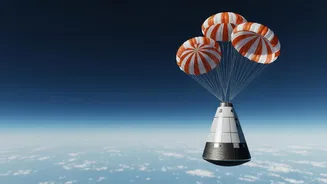
The recent series of tests, officially called Integrated Air-Drop Tests (IADT), are designed to prove this escape system works flawlessly. In these exercises, a test version of the Gaganyaan crew module, matching the weight of the final spacecraft, is lifted to a high altitude by an Indian Air Force Chinook helicopter. Dropped from a height of about 3 to 5 kilometres, the module begins a simulated emergency descent. The test's main purpose is to validate the complex sequence of parachute deployments needed to slow the capsule from high speed to a gentle splashdown in the sea. ISRO has conducted these tests over the Bay of Bengal near its Sriharikota launch centre, with the Indian Navy on hand to recover the module.
A Symphony of Parachutes
Bringing the crew module down safely isn't as simple as pulling a single ripcord. The IADT validates a precise, automated sequence involving ten parachutes of various types. First, smaller drogue parachutes deploy to stabilize and orient the capsule, preventing it from tumbling. After these have done their job, the main parachutes are released. This multi-stage process is essential to gradually decelerate the nearly 5-tonne module to a speed safe enough for splashdown. The successful completion of the IADT-02 test in April 2026 demonstrated that this entire intricate sequence works exactly as designed, a major confidence boost for the mission's engineers.
From the Pad to the Sky
The high-altitude drop tests are part of a wider, more comprehensive testing regime for the Crew Escape System. ISRO had earlier conducted the Test Vehicle Abort Mission-1 (TV-D1) in October 2023. That test simulated an abort at a lower altitude during the ascent phase, using a dedicated test rocket to mimic the conditions of an actual launch. The IADT series takes this further by specifically focusing on the parachute system's performance when deployed from significant height, simulating a different failure scenario. By successfully testing aborts from the launch pad, during ascent, and at high altitudes, ISRO is systematically proving the reliability of its safety systems under a wide range of potential emergencies.
What This Means for Gaganyaan
Every successful test is a critical gate passed on the journey to the first crewed Gaganyaan flight. These demonstrations are not just technical achievements; they are about building an unimpeachable case for human safety. With major milestones like the development of the human-rated launch vehicle (HLVM3) and crew module systems now complete, perfecting the escape and recovery systems was a top priority. The success of high-altitude tests directly clears the path for the next phases: uncrewed orbital test flights. The first uncrewed Gaganyaan mission, G1, is anticipated for the latter half of 2026, which will be a full dress rehearsal without astronauts, followed by the historic first crewed mission.