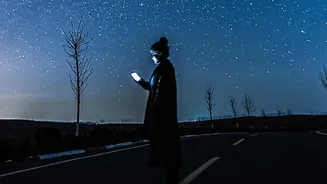







The Challenge of the City Sky
For most urban dwellers in India, looking up at the night sky reveals a familiar, hazy glow. This phenomenon, known as light pollution, is the collective glare from streetlights, buildings, and vehicles. It blankets the sky, washing out all but the brightest
celestial objects like the Moon and a few resilient planets. This can make the hobby of astronomy feel inaccessible, reserved for those with powerful telescopes and access to remote, dark-sky locations. It’s a frustrating reality for anyone curious about the cosmos, turning a potentially awe-inspiring view into an empty canvas.
Your Phone is a Portable Planetarium
This is where your smartphone transforms from a simple communication device into a sophisticated astronomical tool. Modern stargazing apps use a combination of your phone's built-in GPS, compass, and gyroscope to know exactly where you are and which direction you're pointing. They then overlay a detailed star map onto your screen in real-time. This technology, often using Augmented Reality (AR), means you can simply hold your phone up to the sky and it will identify the stars, constellations, and planets you're looking at, even if they're invisible to your naked eye due to city lights.
For a Simple Start: SkyView Lite
If you are brand new to stargazing and want an easy entry point, SkyView Lite is an excellent choice. Its core strength is its simplicity. You just point your phone at the sky, and the app immediately identifies what’s there, from the planet Mars to the International Space Station (ISS) passing overhead. The AR view is intuitive, making it feel like you have a magic window to the cosmos. You don't need Wi-Fi or GPS for it to work, making it perfect for a quick look from your terrace or even during a power cut.
For Deeper Knowledge: Stellarium Mobile
For those who want to go beyond simple identification, Stellarium is a powerhouse. It is a full-featured planetarium that provides a realistic and accurate simulation of the night sky. Its vast catalogue contains thousands of stars, nebulae, galaxies, and other deep-sky objects. You can tap on any object to get detailed information about it. Stellarium is highly valued by both beginners and experienced amateurs for its accuracy and the sheer volume of data it provides, turning your phone into a serious learning tool.
For the Best Visuals: Star Walk 2
If you appreciate a beautiful user interface, Star Walk 2 delivers an immersive experience. It features stunning graphics and 3D models of celestial bodies and constellations, helping you visualise them in a more engaging way. A key feature is the “Time Machine,” which allows you to scroll forward or backward in time to see how the sky will look on a future date or how it looked in the past. The app also includes a calendar of upcoming astronomical events so you never miss a meteor shower or a visible planet alignment.
Tips for Your First Urban Stargazing Session
An app is a great start, but a few simple techniques can enhance your experience. First, find the darkest spot available to you, even if it's just the corner of your balcony shielded from a direct streetlight. Second, give your eyes about 15-20 minutes to adapt to the darkness; you'll be surprised by how much more you can see. Most of these apps have a “night mode” or a red-screen filter. Use it. The red light is less harsh on your eyes and helps preserve your night vision while you consult the app. Finally, start with easy targets. Use your app to locate bright planets like Jupiter and Saturn, or focus on the phases of the Moon before you start hunting for fainter constellations.