






The New Study Buddy: Beyond Spell-Check
For a growing number of students in India and across the globe, finishing an assignment involves one last check-in with an AI tool. This isn't your old-school grammar checker. Modern AI academic assistants like Paperpal, Jenni, and the advanced versions
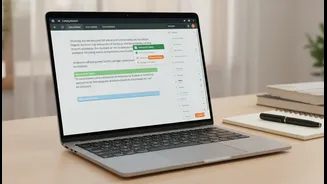
of Grammarly offer a suite of sophisticated features. These tools can paraphrase awkward sentences, suggest a more academic tone, check for plagiarism, and even help generate citations. Some platforms function as a research assistant, allowing students to upload their source materials and ask the AI to synthesize information or find relevant quotes, complete with citations. The goal, for many, is not just to correct errors but to enhance the clarity and quality of their work, turning a good draft into a great one. These tools are often marketed as a way to improve writing and hand in submission-ready work.
Why Students Are Logging On
The reasons behind this new habit are multifaceted. The most obvious is efficiency; in a high-pressure academic environment, AI tools can save valuable time. They offer instant feedback, something a busy professor can't always provide at a moment's notice. For students who may not be native English speakers or who lack confidence in their writing, these tools can act as a crucial support system, helping them articulate their ideas more effectively. A 2025 survey found that 86% of students in India are already using AI tools for tasks like summarising readings and solving problems. The motivation is not always to shortcut learning; many students use AI to better understand complex topics, brainstorm ideas, or ensure their work meets high academic standards. Professor guidance also plays a key role; students are more likely to use AI for deeper learning when encouraged by their instructors.
A Fine Line: Tool or Trespassing?
The rise of AI self-checks inevitably brings up the question of academic integrity. Where does helpful assistance end and cheating begin? The line can be blurry. Using AI to fix grammar is widely accepted, but using it to write entire essays is a clear violation. The grey area lies in between—using AI to rephrase sentences, generate ideas, or structure an argument. Many universities in India are still developing formal policies, leaving students and faculty to navigate this new terrain. The University Grants Commission (UGC) has advised institutions to develop their own guidelines, emphasizing that while AI can be an assistive tool, the student is ultimately responsible for the originality and accuracy of their work. This has led to a patchwork of rules, with some professors banning AI entirely while others permit its use for specific tasks, provided it is disclosed.
The View from the Other Side of the Desk
Educators are grappling with this new reality. Some view AI tools with suspicion, concerned about plagiarism and a decline in critical thinking skills. The fear is that over-reliance on AI could create a generation of students who can't write or think for themselves. However, many also see the potential benefits. A global survey of teachers revealed that a majority believe AI can help streamline routine tasks and personalize learning. In response, some Indian educators are adapting their methods, moving towards in-class handwritten exams or oral quizzes to assess genuine understanding. Others are embracing a hybrid model, teaching students how to use AI responsibly as a tool for problem-solving, much like they would a calculator or a search engine, while still requiring evidence of original thought.
Skills for the Future or a Crutch for Today?
This new productivity habit is more than a trend; it's a reflection of the changing nature of work and knowledge in an AI-driven world. Proponents argue that learning to use these tools effectively is a critical skill for the future. However, there are valid concerns about the risks, including the potential for AI to introduce bias or misinformation, and the erosion of fundamental research and writing skills. The key challenge for the education system is not to ban these tools, but to integrate them thoughtfully. The focus is shifting from trying to detect AI-generated text—a task even OpenAI admits is unreliable—to redesigning assignments that require critical human insight that AI cannot replicate. The ultimate goal is to ensure students use AI not as a crutch, but as a lever to elevate their own thinking and analytical abilities.