
Venus: Earth’s Hellish Twin
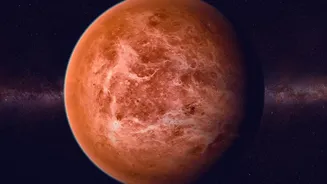
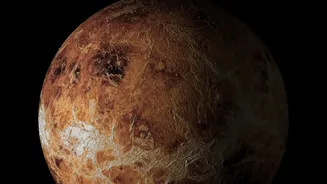
Venus is often called Earth’s twin, but it's more like an evil twin. It’s nearly the same size, but its reality is a planetary nightmare. With a surface temperature hot enough to melt lead and a crushing atmosphere over 90 times denser than Earth's, it’s
one of the most inhospitable places in our solar system. The planet is a cautionary tale of a runaway greenhouse effect, with an atmosphere composed almost entirely of carbon dioxide. Thick, swirling clouds of sulfuric acid completely obscure its surface, making it impossible to see from the outside. For decades, scientists have wondered what secrets these toxic clouds hold about how a planet so similar to our own could have ended up so different. Understanding Venus is not just about exploring another world; it's about gaining crucial insights into planetary evolution and climate change that could be relevant to Earth's own future.
Shukrayaan: India’s Ambitious Successor
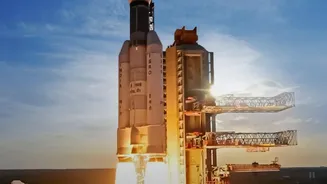
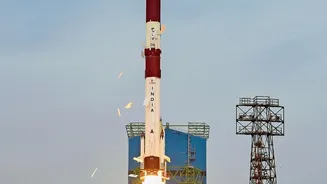
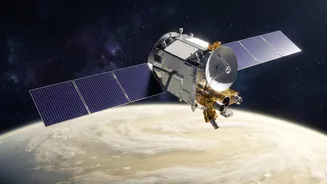
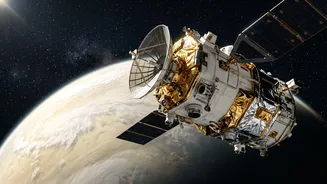
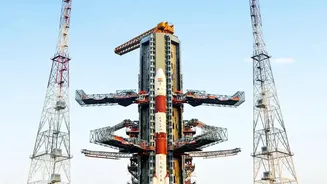
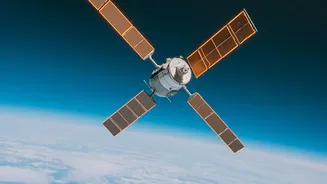
Following the monumental successes of the Chandrayaan moon missions and the Mangalyaan Mars orbiter, the Indian Space Research Organisation (ISRO) is setting its sights on this mysterious neighbour. Officially named the Venus Orbiter Mission (VOM), Shukrayaan-1 represents India's next great interplanetary leap. After receiving formal approval from the Indian government in September 2024, the mission is now on a clear path. The launch is scheduled for March 2028 aboard India's most powerful rocket, the LVM-3. After a journey of about four months, the orbiter will enter a carefully planned orbit around Venus. From this vantage point, it will spend over four years systematically investigating the planet from its molten surface to the top of its complex atmosphere, seeking answers to long-standing questions about its geology and climate.
Decoding the Clouds: A Suite of Smart Sensors
The headline-grabbing goal of the mission is to decode the chemistry of Venus's atmosphere, and ISRO has equipped Shukrayaan with a sophisticated toolkit to do just that. At the heart of this effort is an instrument called VIRAL, short for Venus Infrared Atmospheric Gases Linker. Developed as a collaboration between Russia and France, VIRAL is a specialised spectrometer designed to identify the specific gases present in the Venusian atmosphere. Its primary task is to sniff out the chemical composition, providing data on known elements and searching for unexpected ones. This instrument is particularly crucial for investigating one of the most tantalizing recent astronomical debates: the potential presence of phosphine gas, a possible, though highly contested, sign of biological processes. VIRAL has the sensitivity to potentially confirm or deny these findings once and for all.
More Than Just One Instrument
Decoding the atmosphere requires more than just one sensor. ISRO's plan involves a multi-pronged attack using a suite of instruments working in concert. Alongside VIRAL, the orbiter will carry the Venus Climate Monitoring Camera (VCMC) to track cloud movements and lightning, and the Venus Surface Emissivity and Atmospheric Mapper (VSEAM) to study cloud structure and identify thermal hotspots from volcanic activity. An array of spectrometers will observe the atmosphere in ultraviolet, infrared, and submillimeter wavelengths, each providing a different piece of the puzzle. This comprehensive approach allows scientists to build a complete, three-dimensional model of the atmosphere, from its composition and temperature to its dynamics. The mission won't just be looking at the clouds but also peering through them with a high-resolution Synthetic Aperture Radar (SAR) to map the surface in unprecedented detail, a technique ISRO refined with its Chandrayaan-2 lunar orbiter.
A Global Effort Led by India
Shukrayaan-1 is a testament to India's growing prominence in the global space community. While it is an ISRO-led mission, it features significant international collaboration, showcasing a shared global interest in understanding Venus. Besides the Russian-French VIRAL instrument, Sweden is contributing the Venusian Neutrals Analyser (VISWAS). This instrument will study the interaction between the solar wind—a stream of charged particles from the Sun—and the planet's upper atmosphere, helping scientists understand how Venus lost its water and evolved into its current state. Germany is also a partner, contributing to a radio science experiment. This collaborative spirit not only brings some of the world's best scientific minds and technologies to the mission but also solidifies India's position as a key player in deep-space exploration.