




An Injection Into the Calm
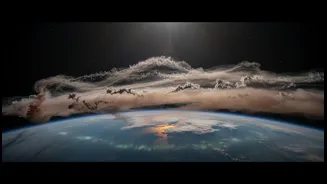
Most of our planet's weather, from gentle breezes to powerful thunderstorms, happens in the troposphere, the lowest layer of the atmosphere. Above it lies the stratosphere, a stable, dry, and cold realm. It's a quiet neighbourhood, largely separated from the turbulent
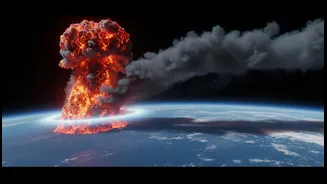
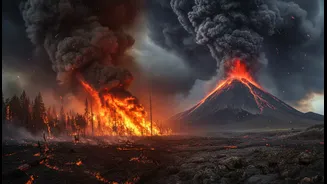
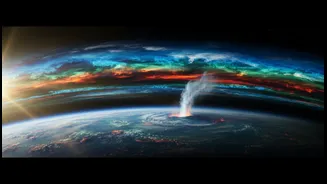
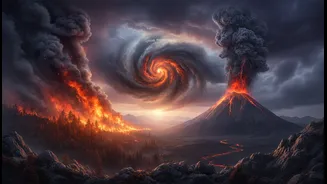
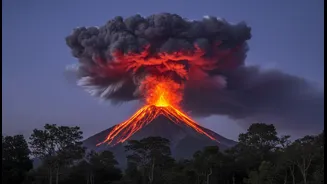
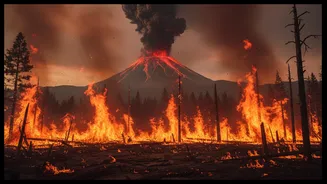
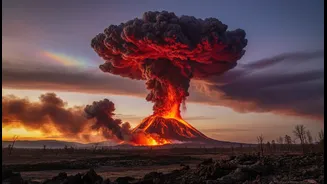
churn below. However, extraordinarily powerful events like massive wildfires and major volcanic eruptions can act like atmospheric elevators. The intense heat from these events creates powerful updrafts, known as pyrocumulonimbus clouds in the case of fires, that are strong enough to blast smoke, ash, and water vapour directly into the stratosphere. Once there, these materials can linger for months or even years, spreading far from their point of origin and influencing a part of the atmosphere that is usually pristine.
The Two Faces of Aerosols
The smoke and ash injected into the stratosphere are composed of tiny particles called aerosols. These particles have a dual and contradictory effect on climate. Depending on their composition, size, and colour, they can either scatter sunlight back into space, creating a cooling effect, or absorb sunlight, which warms the atmospheric layer they occupy. For example, the sulfate aerosols from many volcanic eruptions are highly reflective and are known to cause temporary global cooling. In contrast, black carbon particles from wildfire smoke are dark and efficient at absorbing heat, which can warm the stratosphere. This mix of effects is one of the primary reasons why understanding their net impact is so challenging for climate scientists.
A Surprising Moisture Connection
The stratosphere is typically very dry. However, recent studies have shown that both intense wildfires and volcanic eruptions can significantly increase its moisture content. Wildfires can directly inject water vapour along with smoke particles. Volcanoes, particularly those like the 2022 Hunga Tonga eruption, can launch enormous quantities of water directly into the upper atmosphere. Furthermore, the aerosols themselves change the environment. The warming caused by dark smoke particles can heat the tropopause—the boundary between the troposphere and stratosphere—making it easier for more water vapour from the lower atmosphere to seep into the stratosphere. These particles also act as surfaces for water vapour to condense upon, potentially affecting the formation of thin, wispy clouds in the high atmosphere.
Warming, Cooling, or Just Complicated?
So, does this interaction 'improve' things? The term is tricky because the effects are a mixed bag. On one hand, some aerosols reflect sunlight, which is a cooling effect. On the other hand, some absorb heat, causing localized warming. The addition of water vapour, itself a potent greenhouse gas, further complicates the picture. Increased water vapour in the stratosphere can trap heat and also participate in chemical reactions that deplete the ozone layer. Research following the 2019-2020 Australian wildfires showed that the smoke caused a significant warming of the stratosphere, while the aerosols also altered radiation patterns. The net effect is not a simple thermostat switch but a series of interconnected impacts that can vary greatly from one event to the next.
The Science of Uncertainty
The headline's caution against 'overstated climate certainty' is crucial here. The interaction between aerosols and clouds is one of the single largest sources of uncertainty in all climate projections. These effects are incredibly difficult to model. The exact composition of smoke changes depending on what is burning, volcanic plumes differ in their gas and ash content, and the processes occur in a part of the atmosphere that is difficult to study directly. While scientists can observe the immediate cooling after a major eruption like Pinatubo in 1991, the long-term, subtle effects of wildfire smoke and increased stratospheric water vapour are much harder to pin down. These events provide vital natural experiments, but each one reveals more complexity rather than simple answers.