


When we think of a solar storm, we picture a vast, uniform event. But new research shows the exact opposite: the dangerous effects on Earth can be intensely local, creating high-risk 'hotspots' that can cripple infrastructure without warning.
What are Geomagnetic Storms?
Imagine the
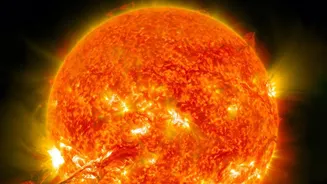
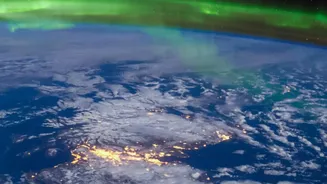
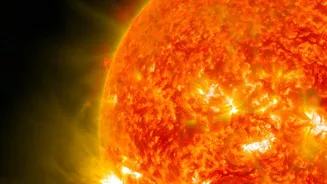
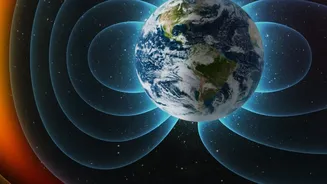
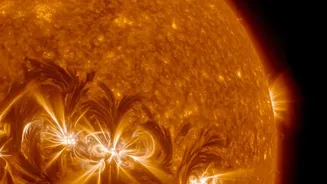
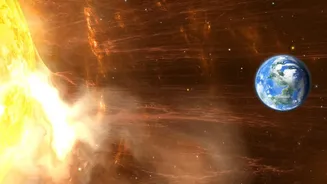
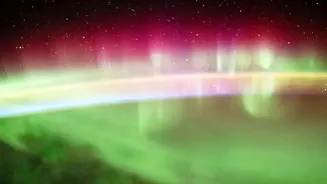
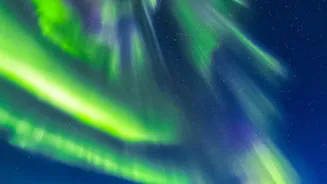
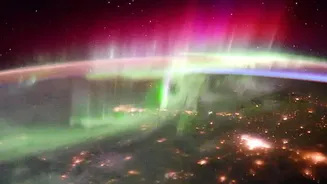
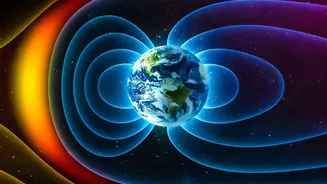
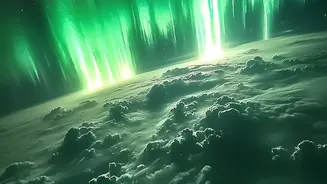
Sun not just as a source of light and heat, but as a dynamic star that occasionally throws massive bursts of energy and charged particles into space. These events are called coronal mass ejections (CMEs). When a CME hurtles towards Earth, its cloud of plasma and magnetic field can slam into our planet's protective magnetic shield, the magnetosphere. This collision triggers a major disturbance known as a geomagnetic storm. While these storms are famous for producing beautiful auroras at the poles, they also carry a significant threat. The rapidly changing magnetic fields during a storm can induce powerful, uncontrolled electrical currents in the ground, known as geomagnetically induced currents or GICs. These currents are the primary cause of concern for our modern, tech-dependent society.
A Surprising New Discovery
For a long time, the prevailing assumption was that the risk from GICs was broadly regional. A storm threatening northern Europe, for instance, was thought to pose a similar level of threat across the whole area. However, recent research, particularly from projects in Europe like the Scandinavian Magnetometer Array, has upended this view. Scientists discovered that the strength of induced ground currents can vary dramatically over surprisingly short distances. During one major storm, the magnetic disturbance between two monitoring stations just 160 kilometres apart differed by a staggering 1,200 nanoteslas. This is not a subtle variation; it’s a hyperlocal 'weather' pattern within the larger storm, indicating that one town could be in the crosshairs for severe impacts while a neighbouring town is relatively unaffected.
The Ground Beneath Your Feet
So why do these hotspots exist? The answer lies not just in the sky, but deep within the Earth's crust. The geology of a specific location plays a crucial role in how it responds to a geomagnetic storm. Some types of rock, like granite, are poor electrical conductors. When a geoelectric field hits an area with this kind of resistive rock, the currents seek an easier path. Unfortunately, the easiest paths are often man-made conductors, like power transmission lines, railway tracks, and pipelines. In contrast, areas with more conductive rock, such as sedimentary basins, may channel these currents safely into the ground. This means the specific geology beneath a substation or a stretch of railway is a critical factor in determining its vulnerability.
Why Local Differences Matter
This new understanding has profound implications for protecting our essential infrastructure. GICs are not friendly currents; they are rogue DC currents injected into AC power grids. This can cause high-voltage transformers—the backbone of our electrical system—to overheat and saturate, leading to voltage instability, equipment damage, and potentially widespread blackouts. The infamous 1989 storm that caused a nine-hour blackout across Quebec is a stark reminder of this threat. The finding that risk is hyperlocal means that a single transformer in a city could be at extreme risk while others nearby are fine. This makes it much harder to predict failures and protect the grid. The risk isn't just to power lines; GICs can also accelerate the corrosion of metal pipelines and interfere with railway signalling systems.
Building a More Resilient Future
The discovery of these localized effects is a call to action. It highlights the urgent need to move beyond broad, regional risk assessments and toward highly detailed, local hazard maps. Researchers are now working to combine data on space weather with detailed geological surveys of Earth's subsurface conductivity to pinpoint these potential hotspots. By understanding which specific parts of our infrastructure are most vulnerable due to the ground they're built on, utility operators and governments can take targeted action. This could involve installing GIC-blocking devices on the most at_risk transformers or developing more sophisticated forecasting models that account for local geology. While we can't stop solar storms, understanding their complex interaction with our planet is the first step toward mitigating their worst effects and ensuring the lights stay on.