


The Cosmic Middle Child
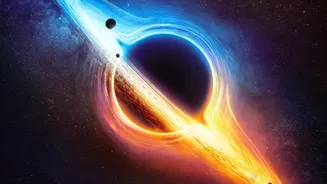
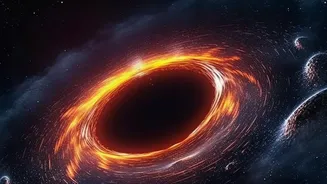
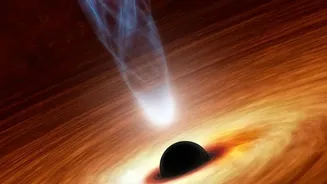
For decades, astronomers have found plenty of evidence for two types of black holes. There are small, 'stellar-mass' ones, typically 5 to 100 times the mass of our sun, formed from the collapse of a single giant star. Then there are the supermassive giants
that lurk at the center of galaxies, including our own Milky Way, weighing millions or even billions of solar masses. But what about the ones in between? This class, known as intermediate-mass black holes (IMBHs), with masses from 100 to 100,000 times that of the sun, have been notoriously hard to find. They are too big to be born from one star, yet their origins are not as clear-cut as their supermassive cousins. This makes them a crucial, yet elusive, 'missing link' in understanding how black holes grow and how galaxies are built.
Listening to Spacetime Ripples
Detecting IMBHs is challenging, but a revolutionary new field of astronomy is changing the game. Instead of looking for light, scientists are listening for gravitational waves—infinitesimal ripples in the fabric of the universe itself. Predicted by Einstein, these waves are created by the most cataclysmic events, such as the collision of two black holes. A global network of incredibly sensitive observatories—LIGO in the United States, Virgo in Italy, and KAGRA in Japan—acts like a giant ear, picking up these faint vibrations. By analyzing the precise shape of a gravitational wave, scientists can determine the masses of the colliding objects. Finding a merger that results in a black hole within the IMBH range is a 'smoking gun' that confirms their existence and provides direct data on their properties.
A Window Into the Past
Each detection of an IMBH merger is more than just finding another object; it's like discovering a fossil from the early universe. Scientists believe that many of these mergers happened billions of years ago, when the universe was younger and galaxies were more actively forming. One prominent theory is that IMBHs act as the 'seeds' for the supermassive black holes we see today. They may have formed in the hearts of small, early galaxies and grown over cosmic time by merging with other black holes and consuming stars and gas. By studying the gravitational waves from these ancient collisions, we get a direct look at this process of 'hierarchical merging'—how small black holes combine to create ever-larger ones. This provides a crucial piece of the puzzle for how the large-scale structure of the universe came to be.
The New Era of Precision Astronomy
The latest observing runs by the LIGO-Virgo-KAGRA collaboration have produced a flood of data, with the catalog of detected events growing rapidly. The latest catalog, GWTC-5, adds 161 new signals, bringing the total to 390 confirmed detections. While many of these are stellar-mass mergers, some are pushing into the crucial intermediate-mass range, like the landmark GW190521 event which resulted in a 142-solar-mass black hole. More recent detections continue to challenge existing theories, revealing a complex population of black holes, including potential 'second-generation' ones born from previous mergers. This wealth of data is transforming gravitational wave detection from an era of initial discovery into one of precision astronomy, allowing scientists to not only confirm IMBHs exist but to start building a census of their population.