




Why August Kicks Off Prime Time
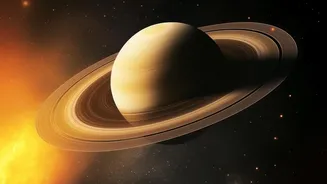
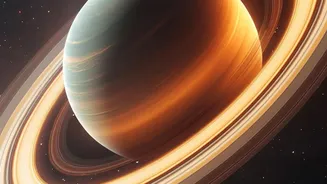
While Saturn will officially be at its biggest and brightest during its 'opposition' on October 4, the weeks leading up to this event are an excellent time for observation. Throughout August, Earth is catching up to Saturn in our orbital paths, causing
the planet to appear progressively brighter and larger in our sky. The planet rises a couple of hours after sunset, climbing higher as the night goes on, making it a fantastic target for late-evening and early-morning stargazing. Conveniently, it will be situated in the constellation Pisces, a relatively dim area of the sky, which helps the bright planet stand out even more.
How to Find the Ringed Planet
Finding Saturn is simpler than you might think. To the naked eye, it appears as a bright, steady, yellowish-white point of light, unlike the twinkling of distant stars. Look towards the eastern sky a few hours after sunset. If you have a clear view, you’ll spot it rising. For an easy win, use the Moon as your guide. On the evening of August 3rd into the 4th, and again from August 30th to 31st, the Moon will pass close to Saturn, making the planet unmistakable. Stargazing apps on your smartphone can also point you directly to its location in real-time.
Your Viewing Guide by Equipment
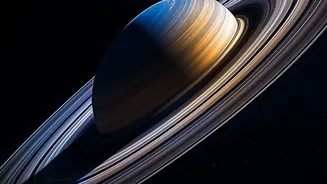
What you'll see depends entirely on the tools you have. With the naked eye, you can easily appreciate Saturn's brightness and distinct golden colour. With a standard pair of binoculars, you can get a better sense of its colour and may notice that it appears slightly oval-shaped, a hint of the rings you can't yet resolve. However, to truly see the rings, you need a telescope. Even a small telescope with a 50mm aperture at 25x magnification will reveal the rings as a separate structure from the planet. This sight is often what gets people hooked on astronomy for life.
A Tour of the Rings and Moons
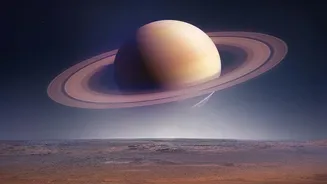
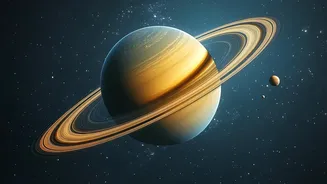
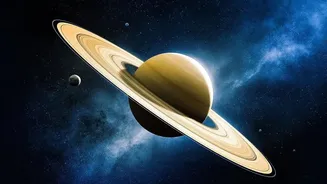
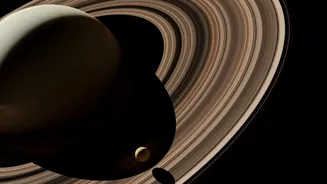
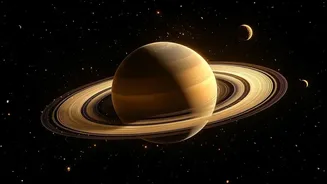
With a 4-inch or larger telescope, the view transforms from a simple dot into a complex system. The most famous feature to hunt for is the Cassini Division, a dark gap that separates Saturn's main A and B rings. Spotting it is a classic test for a clear night and good optics. You can also hunt for Saturn’s moons. The easiest by far is Titan, the second-largest moon in our solar system, which is visible even in good binoculars or a very small telescope. With a modest scope, you may also be able to spot the fainter pinpricks of light that are the moons Rhea, Tethys, and Dione, which orbit much closer to the planet.
Tips for the Best Viewing Night
To maximize your experience, a little preparation goes a long way. First, try to get away from bright city lights; a darker location will always reveal more detail. Second, give your eyes at least 15-20 minutes to fully adapt to the darkness. This will make it much easier to spot fainter objects. Third, check the forecast not just for clouds, but for 'seeing' conditions. A night with steady air, not turbulent or hazy, will allow for much sharper views at high magnification. Finally, dress comfortably for the temperature drop after dark and, most importantly, be patient. The longer you look, the more details your eyes and brain will start to perceive.