





The Fiery Challenge of Re-Entry
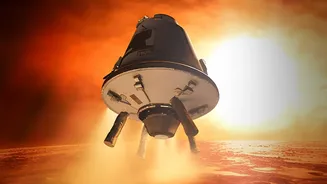
Any object entering a planet’s atmosphere at orbital speeds faces two immense challenges: friction and compression. The vehicle’s incredible velocity compresses the air in front of it, generating temperatures hot enough to melt most metals. At the same
time, this atmospheric drag puts immense physical stress on the spacecraft. For decades, space agencies have relied on rigid heat shields to survive this trial by fire. These have historically come in two main types: ablative shields, which burn away in a controlled manner to dissipate heat, and thermal tiles, like those used on the Space Shuttle, which insulate the spacecraft. While effective, these rigid systems have a fundamental limitation: their size is constrained by the diameter of the rocket's payload fairing. This size limit directly restricts the mass of the payload they can help land, creating a major roadblock for more ambitious missions, such as sending heavy cargo or human crews to Mars.
An Inflatable Answer to a Hard Problem
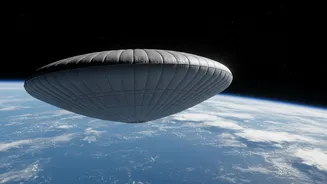
The solution, developed by NASA and other space agencies over the last two decades, sounds almost counterintuitive: an inflatable heat shield. Officially called a Hypersonic Inflatable Aerodynamic Decelerator, or HIAD, the technology is designed to be packed into a small volume for launch and then inflated in space just before re-entry. Once deployed, it expands into a large, mushroom-like shape, creating a much bigger surface area than a rigid shield ever could. This larger diameter is the key. It acts like a giant brake, allowing the spacecraft to begin decelerating much higher up in the atmosphere, where the air is thinner. This results in significantly lower peak heating and reduced stress on the vehicle. In essence, the inflatable shield trades brute-force heat resistance for a more graceful, high-altitude braking maneuver, solving the size-and-weight problem that has long plagued mission designers.
Materials That Can Brave the Inferno
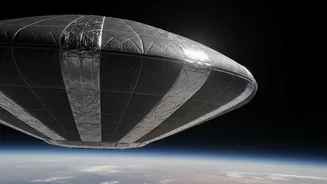
Creating a fabric structure that can survive temperatures reaching nearly 3,000 degrees Fahrenheit is a monumental feat of material science. The system is a multi-layered marvel. The outermost layer, which faces the intense heat directly, is made from a woven ceramic fabric, often using silicon carbide fibers. This material is so fine it can be spun into thread but is exceptionally heat-resistant. Beneath this ceramic skin are layers of flexible insulation designed to stop that heat from reaching the inflatable structure itself. The inflatable part is not a simple balloon; it consists of a series of stacked, woven rings called tori. These rings are made from synthetic polymers that are, by weight, many times stronger than steel, allowing them to remain rigid and maintain the shield's shape when inflated with nitrogen gas. This combination of a flexible, high-temperature outer layer and a strong, inflatable substructure gives the HIAD both its resilience and its game-changing flexibility.
A Successful Real-World Test
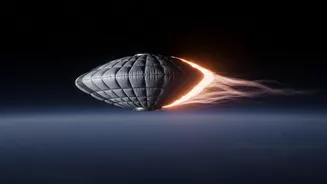
While the theory was sound, the technology needed to be proven in a real-world scenario. That test came in November 2022 with NASA's Low-Earth Orbit Flight Test of an Inflatable Decelerator (LOFTID) mission. Launched as a secondary payload, the six-meter-diameter LOFTID aeroshell was deployed in orbit, inflated, and then directed back toward Earth. It re-entered the atmosphere at more than 18,000 miles per hour (Mach 24), enduring the exact hypersonic conditions it was designed for. The demonstration was a resounding success. LOFTID survived the intense heat and pressure, slowed itself dramatically, and splashed down safely in the Pacific Ocean. The data collected showed that the technology worked as predicted, protecting its payload and maintaining aerodynamic stability. The success of LOFTID moved inflatable heat shields from a promising concept to a flight-proven technology, ready for use in future missions.
Unlocking the Future of Spaceflight
The implications of this technology are enormous. For Mars exploration, HIADs could enable the landing of much heavier payloads, like human habitats and ascent vehicles, at higher elevations than are currently possible. On Earth, the technology offers a path toward the cost-effective recovery of valuable assets. United Launch Alliance is exploring using HIADs to recover the main engines of its Vulcan rocket for reuse. It could also be used to return large components from space stations or bring back materials manufactured in orbit. Because they are lightweight and can be packed tightly, inflatable shields are a mass- and volume-efficient solution that reduces costs and opens up new mission possibilities that were previously impossible with rigid systems. European agencies are also actively developing their own inflatable shields, indicating a broad industry shift toward this flexible, efficient technology.