




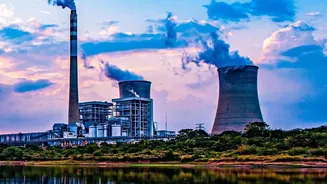


The AI Boom's Thirsty Infrastructure
India's digital transformation is happening at an unprecedented scale. The country's data centre capacity quadrupled from 375 MW in 2020 to 1,500 MW in 2025, with projections showing it could expand to 10,000 MW by 2030. This explosive growth is driven
by the enormous computational needs of artificial intelligence and the widespread adoption of cloud services. Every AI query, every streamed video, and every cloud-based application runs on servers housed in these massive data centres. These servers generate immense heat, and keeping them cool is a non-negotiable operational requirement. Traditionally, this has been a very water-intensive process.
How Data Centres Drink Water
The primary method of cooling for many data centres involves evaporative cooling. Think of it like the industrial-scale version of sweating. Water is circulated through cooling towers, where it absorbs heat from the server equipment and then evaporates, carrying the heat away into the atmosphere. While effective, this process is incredibly wasteful. A single large-scale data centre can consume up to two million litres of water per day using this method. In 2025, India's data centres were estimated to consume around 150 billion litres of water, a figure that is projected to more than double to 358 billion litres by 2030 as the AI build-out accelerates.
India's Unique Challenge: Growth Meets Scarcity
This escalating water consumption presents a critical challenge for India, a nation where nearly 600 million people already face high to extreme water stress. The problem is compounded by the fact that data centre development is heavily concentrated in major hubs like Mumbai, Chennai, Bengaluru, and Hyderabad—cities that are already grappling with well-documented water shortages. This creates a potential conflict between the needs of a burgeoning, high-growth industry and the essential water requirements of communities and agriculture. For the tech industry, this is not just an environmental issue but a significant business risk. Unreliable water access threatens operational continuity and future growth.
The Path to Sustainable Cooling
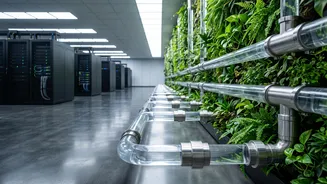
The good news is that the industry is responding with innovative solutions. A new generation of water-efficient cooling technologies is becoming essential. These include closed-loop systems that circulate a fixed amount of coolant indefinitely without evaporation, and direct-to-chip liquid cooling, which applies coolant directly to the hottest components like GPUs. Companies are also exploring immersion cooling, where entire servers are submerged in non-conductive fluids. These methods can reduce water consumption by over 90% and also significantly lower energy use, improving a key efficiency metric known as Power Usage Effectiveness (PUE). Many new data centres in India are now being designed with these technologies from the ground up.
Policy and Innovation Driving Change
Beyond individual company efforts, a broader strategic shift is underway. The Indian government is promoting sustainable practices, with the Ministry of Electronics and Information Technology (MeitY) setting efficiency benchmarks for its IndiaAI Mission projects. While a national data centre policy is still evolving, several states have begun to incorporate sustainability provisions into their policies. The government has also clarified that it expects new data centres to have negligible freshwater demand, pushing them towards using treated wastewater or desalinated water. This combination of technological innovation and policy direction is crucial for ensuring that India's digital ambitions do not come at an unsustainable environmental cost.