




The Challenge of Polar Night
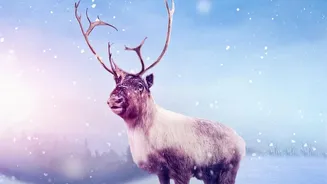
For months, the Arctic is plunged into a state of perpetual twilight known as the polar night. The sun barely rises, casting the world in shades of blue and purple. For most mammals, this low-light environment, combined with a landscape blanketed in uniform
white snow, would make finding food and spotting danger nearly impossible. Snow reflects up to 90% of the ultraviolet (UV) light that hits it, creating a blinding glare for eyes like ours, which have lenses that block UV to prevent damage. Yet, reindeer thrive. Their secret lies not just in their thick fur or sturdy hooves, but in their extraordinary eyes, which have evolved to see the world in a way we can barely imagine.
A Different Kind of Vision
Reindeer are among the very few mammals known to see in the ultraviolet spectrum. While humans see a rainbow from red to violet, reindeer vision extends beyond violet into the UV range. This is crucial because even during the dim winter, the Arctic atmosphere scatters short-wavelength light, making the environment rich in blue, purple, and UV light. Their eyes are uniquely built to let this UV light pass through to the retina, unlocking a hidden layer of information in the landscape. This ability allows them to perceive sharp contrasts that are invisible to other animals. Things that absorb UV light, like certain plants and animal fur, appear as dark shapes against the brightly glowing, UV-reflecting snow.
Eyes that Change with the Seasons
The reindeer's visual system includes another incredible adaptation: their eyes change colour with the seasons. This is due to a reflective layer behind the retina called the tapetum lucidum, the same structure that makes a cat's eyes shine in the dark. In the constant light of summer, the reindeer's tapetum is golden, reflecting most light straight back out. But in the dark winter, it transforms into a deep, vivid blue. This blue version scatters light laterally within the eye, increasing its sensitivity by up to 1,000 times. It makes them far better at seeing in low light, even if it reduces the sharpness of the image. This seasonal shift essentially gives them a set of summer eyes and a set of winter eyes, perfectly tuned to the extreme changes in Arctic light.
Super-powered Foraging and Safety
This combination of UV vision and seasonal eye changes provides a critical survival advantage. The reindeer's primary winter food source is a type of lichen, often called 'reindeer moss', which is typically white and almost impossible for the human eye to spot in the snow. However, this lichen absorbs UV light. To a reindeer, the lichen appears as dark, easy-to-spot patches against the bright snow, allowing them to find food efficiently without wasting precious energy. This same superpower helps them stay safe. The fur of predators like wolves also absorbs UV light, making them stand out clearly against the landscape. Even signs of other animals, like trails in the snow marked by urine, become visible because urine absorbs UV light. This turns the blinding, uniform snowscape into a detailed map of food and danger.
Navigating with Polarised Light
Beyond just seeing UV light, evidence suggests many animals use the polarisation of light for navigation. Light from the sun becomes polarised as it scatters in the atmosphere, creating patterns in the sky that can act as a compass, even on cloudy days or during twilight. While direct research into reindeer polarisation vision is still developing, their ability to navigate vast, featureless terrain during long migrations hints at this capability. For animals that can perceive it, polarised light offers another layer of directional information, helping them maintain their course over long distances. This would be an invaluable tool for navigating the immense and seemingly uniform Arctic tundra, ensuring the herds can find their seasonal grazing grounds year after year.