




Why Bodyweight Training Works
Building muscle relies on a simple principle: resistance. Your muscles don't know if that resistance comes from a dumbbell or from leveraging your body against gravity. Calisthenics exercises are highly effective because they often involve compound movements,
meaning they work multiple muscle groups at once. Exercises like push-ups and rows engage not just your chest and back, but also your shoulders, arms, and core for stability. This integrated approach builds functional strength that translates to real-world activities, improves body control, and enhances joint stability by engaging smaller stabilizing muscles that gym machines often bypass. The best part is the accessibility; you can do it anywhere with minimal equipment and modify exercises to suit any fitness level.
The Key to Growth: Progressive Overload
To continuously build muscle, you must consistently challenge your body. This is called progressive overload. It means that as you get stronger, you need to make your workouts harder to force your muscles to keep adapting and growing. In calisthenics, you can't just add another plate to the bar, but you have several other tools to increase the difficulty. You can increase the number of repetitions (reps) or sets, decrease your rest time between sets, slow down the movement to increase time under tension, or progress to a more challenging variation of an exercise. For example, once you can comfortably perform several sets of knee push-ups, you can advance to full push-ups to continue making gains.
The Foundational Upper Body Routine
This routine is built on fundamental pushing and pulling movements to ensure a balanced workout for your entire upper body. Aim to perform this workout two to three times per week, with at least one rest day in between to allow your muscles to recover and grow. Focus on maintaining proper form over completing more reps; quality is more important than quantity. For each exercise, aim for 3-4 sets of 8-15 repetitions. Rest for 60-90 seconds between sets. When you can comfortably complete the top end of the rep range for all sets, it's time to move to a harder variation.
Exercise 1: The Push-Up (Chest, Shoulders, Triceps)
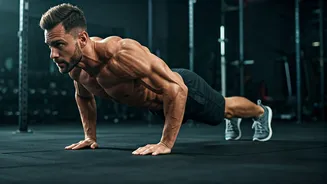
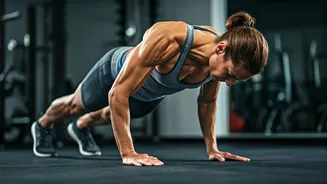
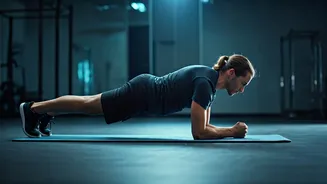
The push-up is a classic compound exercise that is foundational for upper body strength, targeting the chest, shoulders, and triceps. To perform one, start in a high plank position with your hands slightly wider than your shoulders. Keep your body in a straight line from head to heels, engaging your core and glutes. Lower your body by bending your elbows until your chest is just above the floor, then push back up to the starting position. To make it easier, you can perform push-ups on your knees or with your hands on an elevated surface like a bench or wall. To make it harder, elevate your feet on a step, slow down the lowering phase, or work toward single-arm variations.
Exercise 2: The Inverted Row (Back and Biceps)
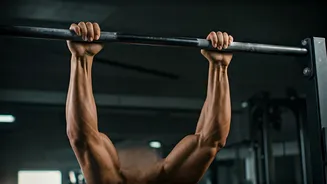
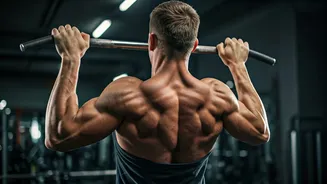
To balance out the pushing motion of push-ups, you need a pulling exercise. Inverted rows are one of the best bodyweight options for strengthening your upper back and biceps. You can perform these using a sturdy table, a bar set low on a Smith machine, or even a broomstick placed securely between two chairs. Position yourself under the bar or table edge, gripping it with hands slightly wider than your shoulders. Keeping your body in a straight line, pull your chest toward the bar, squeezing your shoulder blades together at the top of the movement. Slowly lower yourself back to the start. The more horizontal your body is, the harder the exercise becomes.
Exercise 3: The Pike Push-Up (Shoulders)
Pike push-ups are an excellent way to target your shoulders and are a stepping stone to more advanced movements like handstand push-ups. Begin in a downward dog yoga position, with your hands on the floor and your hips lifted high, creating an inverted V shape with your body. Keeping your legs as straight as possible, bend your elbows to lower the top of your head toward the floor. Press through your palms to extend your arms and return to the starting position. To increase the difficulty, you can elevate your feet on a box or chair.
Exercise 4: Dips (Triceps and Chest)
Dips are another powerful pressing movement that heavily targets the triceps and lower chest. For this routine, you can use a sturdy chair, bench, or the edge of a sofa. Sit on the edge of the bench and place your hands beside your hips, fingers pointing forward. Move your hips off the bench and extend your legs in front of you. Slowly bend your elbows to lower your body, keeping your elbows pointing straight back. Lower yourself until your shoulders allow, then press through your hands to return to the start. To make it harder, elevate your feet on another surface.