


A New Way to Find Hidden Worlds
In a remarkable recent discovery, astronomers using NASA's James Webb Space Telescope (JWST) found a giant planet that had been hiding in plain sight. The star system, Beta Pictoris, was already one of the most studied in our galaxy, known to host two
large planets. This new world, named Beta Pictoris d, wasn't found as a point of light but through a revolutionary new technique. Instead of a direct photograph, scientists detected the chemical signature of its atmosphere, identifying traces of methane, carbon monoxide, and water vapor that betrayed its presence. This method of spotting a planet by its atmospheric fingerprint is a game-changer, allowing astronomers to find worlds concealed by bright cosmic dust and debris that would normally blind conventional imaging methods. It proves that even in well-known systems, major discoveries are still waiting to be made.
Mapping the Universe's Skeleton
Beyond individual planets, scientists are now able to see the universe's grand architecture. For the first time, astronomers have captured a detailed image of a filament of the 'cosmic web' — the vast, hidden structure of gas and dark matter that connects galaxies across billions of light-years. Modern cosmological theories predict that the universe is built on a web-like framework of dark matter, with galaxies forming at the intersections of these massive filaments. Recent observations have provided a direct look at a glowing strand of intergalactic gas stretching over 3 million light-years, funneling fuel into two galaxies as they existed nearly 12 billion years ago. Capturing this faint glow confirms long-held theories about how galaxies grow and evolve, showing us the intergalactic highways that channel the raw materials for star birth.
The Telescopes Peering Through the Veil
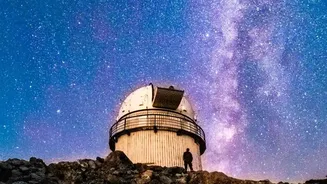
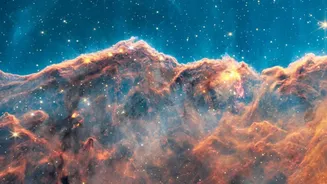
These breakthroughs are powered by a new generation of observatories. The James Webb Space Telescope, with its incredible sensitivity to infrared light, can see through cosmic dust and capture light from the earliest eras of the universe. This allows it to analyze the atmospheres of distant exoplanets and see the first galaxies forming. At the same time, the European Space Agency's Euclid telescope is on a different but equally important mission. Launched to map the influence of dark matter and dark energy, Euclid is creating an enormous survey of the sky. In July 2026, it found more than 30 of the most ancient quasars ever seen, doubling the number of known objects from that primordial era. These quasars—incredibly bright galactic cores powered by supermassive black holes—challenge our understanding of how such massive objects could form so quickly after the Big Bang.
Unveiling Our Own Galaxy's Heart
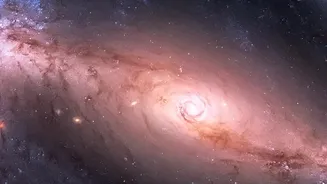
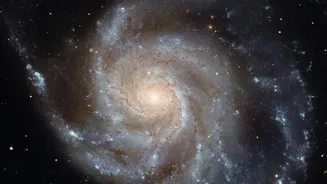
The new tools aren't just for looking at distant galaxies; they are also providing breathtaking new views of our own Milky Way. In June 2026, the Euclid mission released the largest and most detailed high-resolution photo ever taken of our galaxy's crowded center. The six-gigapixel image captures over 60 million stars in a single observation, offering a stunningly clear view of the galactic bulge, a tightly packed region of older, cooler stars some 26,000 light-years away. While beautiful, this unprecedented detail serves a scientific purpose. Astronomers can use these sharp images to hunt for exoplanets in the dense starfields and to better understand the structure and evolution of our galactic home.