




A Cosmic Firework Display
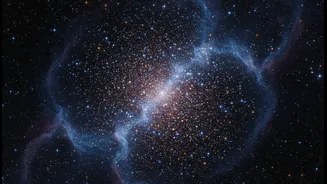
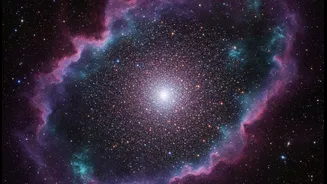
In a recent release that lit up the astronomical community, NASA unveiled a breathtaking new image from the Hubble Space Telescope described as a stellar sparkler. The subject of this cosmic portrait is Messier 3, a gigantic, tightly-packed sphere of more
than 500,000 stars. These vast, ancient star groupings are known as globular clusters, and they act as time capsules from the early universe. While the 'sparkler' nickname is a nod to its dazzling appearance, the real fireworks are the scientific insights it provides. Messier 3, and other clusters like it, are among the oldest objects in our galaxy, offering a direct window into a past that is otherwise lost to time. By studying the light from these stellar relics, astronomers can piece together the story of how our Milky Way galaxy grew and evolved.
What are Globular Clusters?
Imagine a city of stars, but one where all the inhabitants were born at the same time in the same neighborhood. That’s essentially a globular cluster. They are dense, spherical collections of hundreds of thousands, or even millions, of stars, all bound together by their mutual gravity. They orbit in the outer regions of galaxies, a sparse area known as the halo. Because all the stars in a cluster formed from the same primordial cloud of gas, they share a common age and initial chemical composition. This makes them perfect natural laboratories. By observing stars of different masses but the same age, scientists can test and refine their theories of stellar evolution. When these clusters are almost as old as the universe itself, like the 13-billion-year-old NGC 6426, they preserve a pristine record of the conditions just a few hundred million years after the Big Bang.
Clues of Ancient Mergers
One of the most fascinating discoveries within clusters like Messier 3 is that they aren't as simple as they first appear. Astronomers once thought all stars in a globular cluster formed in a single event. However, detailed Hubble observations have revealed that many contain at least two distinct populations of stars with different chemical makeups. This discovery has led to a compelling new theory: some of these massive clusters may not be single entities at all, but the result of ancient mergers. The leading hypothesis suggests that two smaller star clusters, likely from a dwarf galaxy, collided and merged billions of years ago. That dwarf galaxy was later swallowed by the much larger Milky Way, leaving the merged cluster behind as a fossil of a long-ago cosmic feast. This process helps explain how large galaxies like our own were assembled over eons—by absorbing smaller ones.
The Puzzle of 'Forever Young' Stars
Among the ancient, reddish stars that dominate these old clusters, Hubble has spotted something peculiar: bright, blue stars that appear far too young to be there. Dubbed 'blue stragglers,' these stars have puzzled astronomers for decades. In a population of 13-billion-year-old stars, how can some look like they're millions, not billions, of years old? The answer seems to be a form of stellar vampirism. In the crowded center of a globular cluster, stars can interact and even collide. A blue straggler is thought to be an old star that has siphoned gas from a companion star, or merged with one entirely. This infusion of new material adds mass and effectively 'rejuvenates' the star, causing it to burn hotter and shine brighter and bluer, giving it the appearance of youth. These stellar oddities provide crucial clues about the chaotic, gravitational dynamics at the heart of these dense clusters.