


What is an AI-VR Classroom?
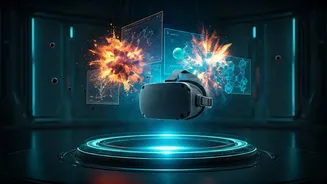
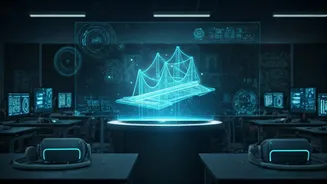
First, let's break down the jargon. Virtual Reality (VR) uses a headset to immerse you in a computer-generated, 3D environment. You can look around, interact with objects, and feel like you’re actually there. Now, add Artificial Intelligence (AI) to the mix.
The AI acts as a smart, personal tutor within this virtual world. It can track a student's progress, identify areas where they are struggling, and adapt the lesson in real-time. For instance, if you’re having trouble understanding photosynthesis, the AI could generate a new, simpler visual model or offer a pop-up quiz to reinforce the concept. It’s the difference between watching a movie about the solar system and having a guided tour where your guide knows exactly what you need to learn next.
Bringing Science to Life
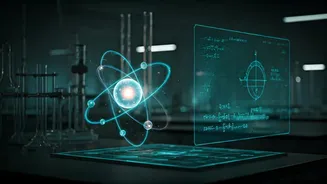
The potential for science education is immense. Complex, abstract concepts become tangible. Instead of memorising the structure of a DNA molecule from a 2D diagram, students can put on a headset and ‘fly’ through the double helix, seeing how the base pairs connect. Difficult or dangerous experiments, like mixing volatile chemicals or dissecting an animal, can be performed in a completely safe, repeatable virtual lab. This not only democratises access to high-end lab equipment but also addresses ethical concerns. Field trips, often limited by budget and logistics, become boundless. Students could visit the Amazon rainforest to study biodiversity, journey to the centre of the Earth to learn about geology, or witness the Big Bang, all within a single class period. This immersive approach fosters curiosity and can lead to much deeper, more memorable learning.
The Benefits Beyond 'Wow' Factor
The core advantage of an AI-powered VR classroom is personalised learning at scale. In a traditional classroom of 40 students, it's impossible for a teacher to give everyone individual attention. The AI can provide that one-on-one guidance, allowing students to learn at their own pace. Those who grasp concepts quickly can move on to more advanced modules, while those who need more time can review materials without feeling left behind. This technology also helps students develop critical spatial reasoning and problem-solving skills. By manipulating virtual objects and navigating complex environments, they are training their brains in ways that a textbook simply cannot. Furthermore, for students with certain physical disabilities, VR can offer access to experiences that might otherwise be impossible, creating a more inclusive learning environment.
Reality Check: Hurdles for India
While the vision is exciting, the path to implementation in India is filled with significant challenges. The most obvious is cost. High-quality VR headsets and the powerful computers needed to run them are expensive, making them inaccessible for the vast majority of government and low-fee private schools. Then there is the infrastructure problem. Seamless VR requires high-speed, stable internet, a luxury still not available across large parts of the country. Beyond the hardware, there is the crucial human element. Teachers would require extensive training to not only use the technology but also integrate it effectively into their curriculum. Without proper pedagogical support, these expensive tools could end up as little more than fancy gadgets gathering dust. The digital divide, which separates urban and rural students, could widen even further if this technology is only adopted by elite, well-funded institutions.
So, Is It Happening?
Yes, but in small, experimental pockets. Several top-tier engineering institutes and private universities in India have begun setting up VR labs. The government’s National Education Policy (NEP) 2020 also emphasises the use of technology and virtual labs to enhance learning. Platforms like DIKSHA have already made some digital content accessible, and it’s a logical next step to explore more immersive technologies. A few Indian ed-tech startups are venturing into this space, creating bespoke content for the Indian curriculum. However, for the average student, a full-fledged AI-VR science class is still a distant dream. What’s more likely in the near term is a hybrid model, where schools might have a single 'VR lab' for students to use on a rotational basis for specific, hard-to-visualise topics.