





Welcome to Aphelion
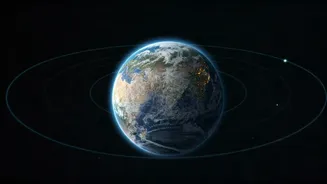
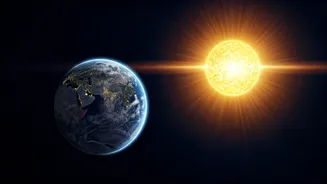
The celestial event hiding in your July calendar is called aphelion. The word comes from Greek roots meaning “away from the sun,” and that’s exactly what it describes. On July 6, 2026, Earth will be at aphelion, its farthest point from the Sun for the entire
year. At that moment, our planet will be roughly 152 million kilometres away from our star. This is a natural consequence of Earth's orbit, which isn't a perfect circle but a slight oval, or ellipse. This elliptical path means our distance from the Sun changes throughout the year. While aphelion marks the most distant point, the closest point, called perihelion, happens in early January when Earth is about 5 million kilometres closer to the Sun.
Further Away, But Not Colder
A common assumption is that being farther from the Sun should make our weather colder. It seems logical—stand farther from a fire, and you feel less heat. However, for those in the Northern Hemisphere, aphelion occurs right in the middle of summer. This is the clearest proof that our distance from the Sun is not the main driver of our seasons. The variation in distance is relatively small; across the whole year, our distance to the Sun only changes by a little over three percent. While sunlight is about 7% less intense at aphelion compared to perihelion, this has a minimal effect on global temperatures and is easily overridden by other factors. In fact, a persistent myth that aphelion will cause extreme cold has been repeatedly debunked by scientists.
The Real Reason for the Seasons
If not distance, then what causes seasons? The answer lies in Earth’s axial tilt. Our planet is tilted on its axis by about 23.5 degrees. It’s this tilt that determines the seasons. During the Northern Hemisphere’s summer, which includes July, this part of the Earth is tilted toward the Sun. This means the sun's rays hit it more directly, and the days are longer, leading to warmer weather. At the same time, the Southern Hemisphere is tilted away from the Sun, so it experiences winter. The seasons are a result of which hemisphere is getting more direct solar energy, not how close the planet is to the Sun as a whole.
A Subtle Effect: A Longer Summer
While aphelion doesn't dictate our temperatures, it does have a fascinating, subtle effect on the calendar itself. According to Kepler's second law of planetary motion, a planet moves slowest when it is farthest from the Sun and fastest when it is closest. Therefore, Earth is moving at its slowest orbital speed in early July during aphelion, about 29.3 kilometres per second. At perihelion in January, it speeds up to about 30.3 kilometres per second. This slower journey during the Northern Hemisphere’s summer means that this season is actually a few days longer than the summer in the Southern Hemisphere. So, while aphelion doesn't make it colder, it does give the northern half of the world a slightly longer summer season.