





A Cosmic Mystery in Red
Since the James Webb Space Telescope (JWST) began delivering its stunning images in 2022, astronomers have been captivated by a strange new class of objects: little red dots, or LRDs. These faint, compact objects appear in large numbers in the very early
universe, around 600 million years after the Big Bang, but seem to vanish as the cosmos matures. Their nature has been a pressing puzzle. Were they a unique type of galaxy bursting with star formation, or something else entirely? This sudden appearance and disappearance challenged existing models of cosmic evolution, sending scientists on a hunt for an explanation.
Enter the Supermassive Black Holes
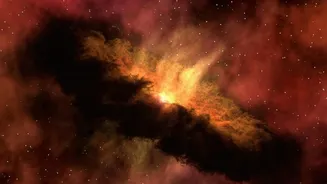
The leading theory quickly became that these LRDs were not just galaxies, but homes to ravenously growing supermassive black holes, also known as active galactic nuclei (AGN). The idea is that these black holes are so furiously consuming gas and dust that they are cocooned in a thick, dense shroud. This cocoon absorbs most of the intense light from near the black hole and re-radiates it in the infrared spectrum, which the JWST observes as a distinct reddish hue, giving the LRDs their name. Essentially, we are not seeing the object directly, but the glowing, dusty shell that hides the furiously active black hole within.
A Galaxy Called Saguaro
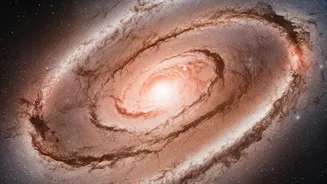
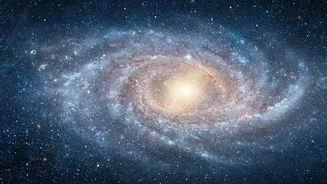
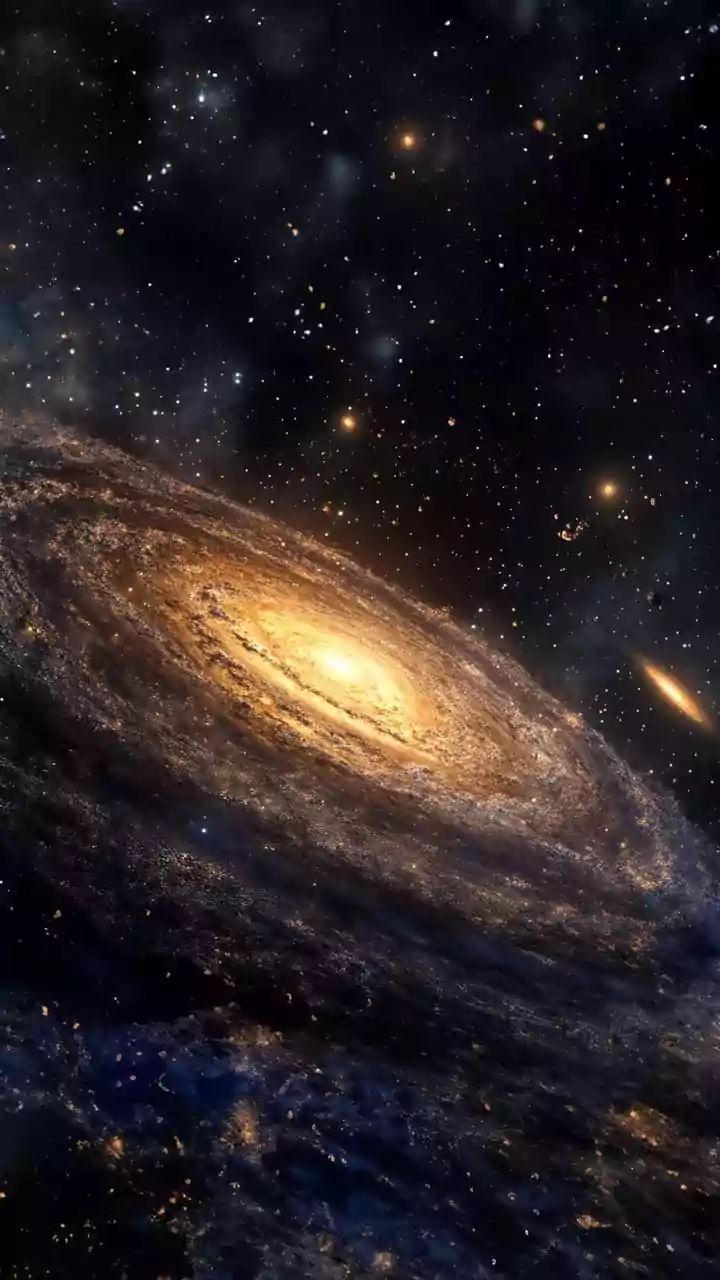
The original headline's focus on using active black holes to study LRDs points to a clever new research method. A recent study published in The Astrophysical Journal provides a compelling link by studying a more recent galaxy. Scientists focused on a spiral galaxy nicknamed "Saguaro," which exists about 3.3 billion years after the Big Bang and has a compact, red centre that looks just like an LRD. Because Saguaro is closer, astronomers can study it in much greater detail. The research team used computer models to synthetically shift Saguaro to a higher redshift, simulating how it would look if it were in the early universe. The result was a dead ringer for a little red dot.
A Temporary, Messy Phase
The Saguaro study suggests that being a 'little red dot' is not a permanent identity but a temporary, albeit dramatic, phase in a galaxy's life. According to this model, LRDs are what we see when a galaxy's central supermassive black hole is going through an intense growth spurt, shrouded in dust. As the universe evolves, a few things could happen. The black hole might clear away its dusty cocoon, changing its appearance. Or the surrounding galaxy, which was too faint to be seen from billions of light-years away, becomes more visible as our observational tools get better. The Saguaro galaxy shows that a structure exists around the red dot core. This implies that many LRDs may not be a unique type of object but are simply the overwhelmingly bright, dusty cores of galaxies that we couldn't fully resolve until now.
The Future of Cosmic Puzzles
This new understanding transforms how astronomers will approach the study of the early universe. By identifying local analogues like Saguaro, scientists can create a 'family tree' to trace how these enigmatic objects from the dawn of time evolve into the galaxies we see around us today. The mystery of why LRDs seemed to disappear is at least partially solved: they didn't vanish, they just changed their appearance. This method of using nearby objects to understand faraway ones is a powerful new tool in the astronomical kit. It suggests that many of the JWST's most profound discoveries may come from connecting the cosmic dots between the ancient past and the more recent present.