
Before Webb: A Numbers Game
Until recently, our exoplanet hunt was largely a numbers game driven by missions like the Kepler Space Telescope. These powerful observatories were brilliant at finding planets using the 'transit method'—detecting the tiny dip in a star's light as a planet passes
in front of it. This method confirmed thousands of worlds, giving us a galactic census of planets of all shapes and sizes. However, it told us little more than a planet's size and how close it orbited its star. It was like having a map of a new city but no information about its buildings, streets, or inhabitants. We knew where the planets were, but their nature—what they were made of, what their atmospheres held—remained largely a mystery.
The Infrared Revolution
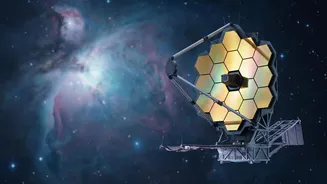
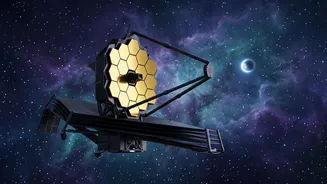
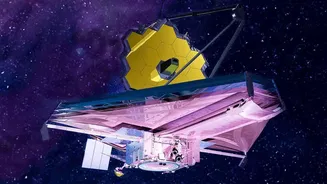
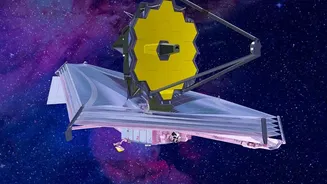
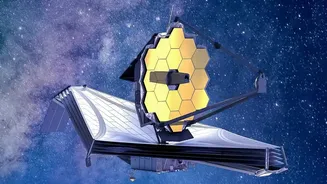
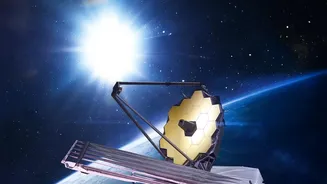
Enter the James Webb Space Telescope, an observatory engineered not just to find planets, but to know them. Webb’s superpower is its unparalleled vision in the infrared spectrum. Think of it as trading a standard camera for a high-tech thermal imager. While the Hubble Space Telescope operates mainly in visible and ultraviolet light, Webb is optimized for longer, redder wavelengths. This is crucial for two reasons. First, infrared light can pierce through the cosmic dust clouds that obscure many star-forming regions, giving us a clearer view. Second, and most importantly for exoplanets, the chemical clues hidden in a planet's atmosphere are most visible in infrared light. Webb's enormous 6.5-meter primary mirror, over six times larger in area than Hubble's, allows it to collect more of this faint light, enabling it to see things up to 100 times fainter than Hubble could.
Decoding Alien Atmospheres
So, how does this work in practice? When an exoplanet transits its star, a tiny fraction of the starlight filters through the planet's atmosphere. The gases in that atmosphere absorb specific wavelengths, or colors, of light. This leaves a unique chemical 'barcode' imprinted on the starlight that finally reaches the telescope. Using its advanced spectrographs, which spread light out like a prism, Webb can read this barcode with incredible precision. This technique, called transmission spectroscopy, allows astronomers to identify the molecules present, such as water vapor, methane, and carbon dioxide. It has effectively upgraded exoplanet science from the discovery phase to the characterization phase, turning distant dots into worlds with distinct chemical profiles.
Early Wins and Surprising Worlds
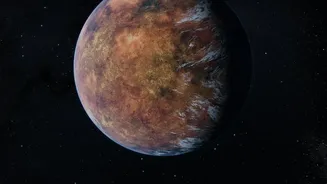
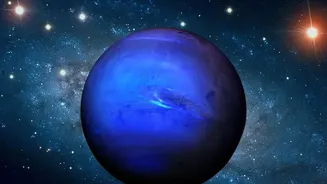
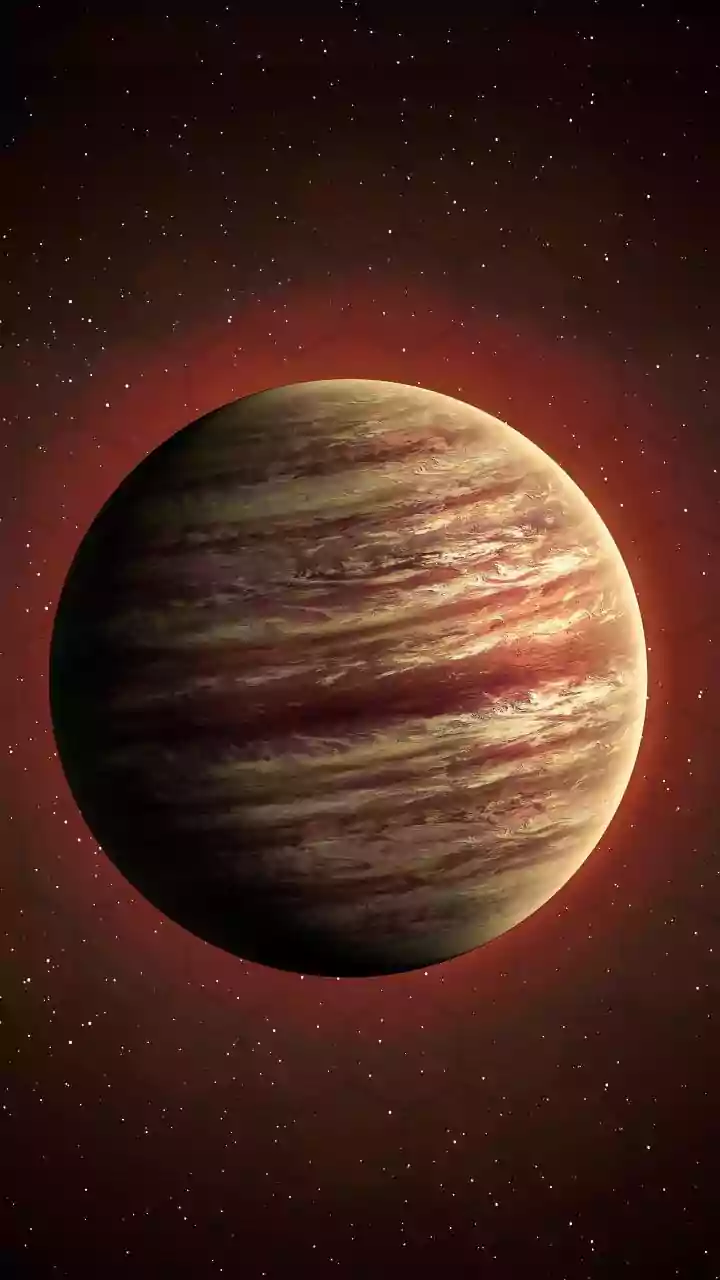
The results have already been staggering. On the 'hot Saturn' exoplanet WASP-39b, Webb provided the first-ever detection of sulfur dioxide in an exoplanet's atmosphere, a molecule created by light-driven chemistry. On another world, WASP-17b, it found clouds made of microscopic quartz crystals. Perhaps most tantalizingly, observations of K2-18 b, a 'sub-Neptune' planet in its star's habitable zone, revealed methane and carbon dioxide. This suggests it might be a 'Hycean' world—a planet with a water ocean under a hydrogen-rich atmosphere. Some studies even reported a tentative hint of dimethyl sulfide (DMS), a gas that, on Earth, is primarily produced by life, though this finding remains under intense scientific debate.
A Reality Check for Rocky Planets
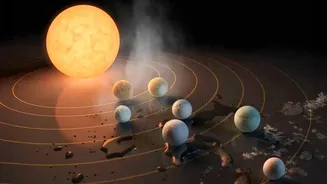
JWST is not just delivering exciting confirmations; it's also providing crucial reality checks. The TRAPPIST-1 system, with seven Earth-sized rocky planets just 40 light-years away, has long been a top target in the search for habitable worlds. However, Webb's observations have so far been sobering. The two innermost planets, TRAPPIST-1 b and c, appear to be bare rocks with little to no atmosphere. Further studies of TRAPPIST-1 d and e have also failed to find signs of a thick, Earth-like atmosphere, ruling out many of the most optimistic scenarios for habitability. While disappointing for alien-hunters, this is vital science. It helps astronomers understand how the intense activity of red dwarf stars can strip atmospheres from their planets, refining our understanding of what makes a world truly habitable.