




The Latest 'Pushpak' Landing Test
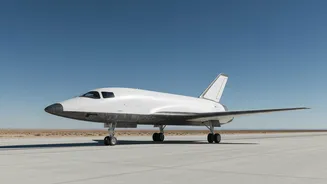
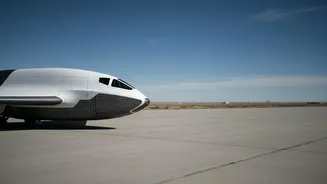
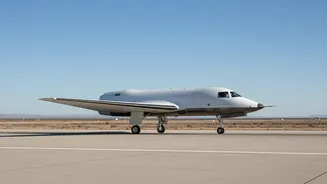
In a series of crucial tests, ISRO has successfully demonstrated the autonomous landing capability of its Reusable Launch Vehicle (RLV). The winged test vehicle, nicknamed 'Pushpak', was carried to an altitude of 4.5 kilometres by an Indian Air Force
Chinook helicopter and released to simulate the final phase of a return from space. In its most recent Landing Experiment (LEX), Pushpak had to autonomously navigate under more challenging wind conditions and from a wider offset distance from the runway at Aeronautical Test Range in Chitradurga, Karnataka. The vehicle successfully managed its trajectory, approached the runway at high speed, and executed a precise, horizontal landing, proving the robustness of its indigenous control systems.
What is a Reusable Launch Vehicle?
Think of a conventional rocket as a disposable product; its most expensive parts, the powerful engines and complex structures, are discarded and burn up in the atmosphere or fall into the ocean after a single use. A Reusable Launch Vehicle, as the name suggests, is designed to be more like an airplane. Its key components can return to Earth, land safely, be refurbished, and used for multiple missions. This reusability is the holy grail for making space access cheaper. ISRO's goal is to develop a Two-Stage-to-Orbit (TSTO) vehicle where the first stage, after boosting the second stage and payload, would fly back and land on a runway, ready for its next flight.
The Economics of Reusability
The primary driver behind the RLV program is cost. Launching satellites is an expensive business, and a significant portion of that expense comes from the single-use hardware of the rocket. By reusing the most complex and costly parts, ISRO aims to dramatically slash the cost of putting a satellite into orbit. The target is ambitious: to reduce launch costs by up to 80%, from an estimated $20,000 per kilogram to a fraction of that. Lower costs would make India an even more competitive player in the multi-billion dollar global satellite launch market, attracting more international customers and strengthening the commercial viability of India's space program.
India's Winged Approach
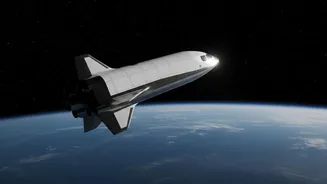
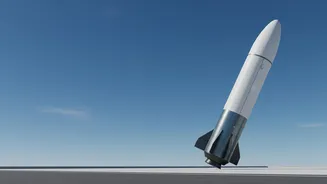
Different agencies are pursuing different paths to reusability. While companies like SpaceX have mastered vertical landings for their rocket boosters, ISRO has opted for a winged body design for Pushpak. This configuration resembles a spaceplane and is designed for a horizontal landing on a conventional runway, much like an aircraft. This approach requires mastering a different set of complex technologies, including hypersonic flight during re-entry, advanced thermal protection systems to withstand extreme temperatures, and sophisticated autonomous navigation and control systems for a high-speed landing that exceeds 320 kmph.
The Road Ahead for ISRO
The successful landing experiments are a critical milestone, but they are just one part of a longer journey. These tests simulated the final approach and landing phase. The next major challenge is the Orbital Re-entry Experiment (ORE). In this future mission, a larger version of Pushpak will be launched into orbit on a conventional rocket, spend time in space, and then perform a full re-entry, autonomously navigating its way back through the atmosphere to land on a runway. Mastering this phase is essential for realising the full potential of a Two-Stage-to-Orbit launch system. These efforts are part of a broader vision that includes developing a Next Generation Launch Vehicle (NGLV) to support future missions like the Bharatiya Antariksh Station.