





Signatures in Starlight
The discovery isn't like seeing clouds through a telescope. Instead, scientists are using a clever technique called transmission spectroscopy. When an exoplanet passes in front of its host star from our perspective, a tiny fraction of the starlight filters
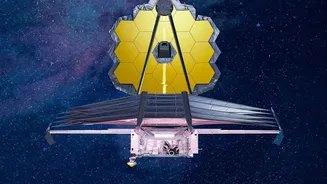
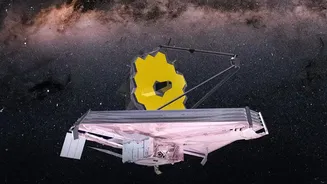
through the planet's atmosphere, if it has one. The gases in that atmosphere absorb specific colours, or wavelengths, of light. The James Webb Space Telescope (JWST) is sensitive enough to catch this incredibly subtle dimming at precise wavelengths. By analysing the pattern of missing light—the spectrum—astronomers can identify the molecules present, such as methane, carbon dioxide, and the key ingredient for life as we know it: water. Recent observations of a temperate, rocky world 48 light-years away have provided one of the clearest atmospheric profiles to date, showing unambiguous signs of water vapour.
A Gallery of Strange New Worlds
Webb isn't just looking at one type of planet; it's building a catalogue of alien atmospheres across a range of rocky worlds. One major success story is 55 Cancri e, a “super-Earth” 41 light-years away. While it's a scorching-hot lava world far too hostile for life, Webb has found the best evidence yet for a substantial atmosphere on a rocky planet outside our solar system, likely composed of carbon monoxide or carbon dioxide. This proves the technology can work. Then there are planets like GJ 486 b, where tentative hints of water vapour have been detected. However, scientists are cautious, as the signal could potentially be coming from cool spots on the star itself—a phenomenon known as stellar contamination. This highlights the careful, detective-like work required to confirm these findings. These efforts build a more complete picture of planetary evolution.
The Search for Another Earth
The ultimate goal for many is to find a true Earth-twin. One of the most promising candidates for future study is Gliese 12 b, located just 40 light-years away. This planet is roughly the size of Earth and has an estimated surface temperature of about 42 degrees Celsius, assuming it has no atmosphere. This makes it one of the nearest, most temperate Earth-sized worlds ever found, and a prime target for Webb to investigate for an atmosphere. Its host star is also relatively calm, increasing the chances that any atmosphere the planet once had might still be intact. Answering whether Gliese 12 b has an atmosphere—and what it’s made of—is a crucial next step in the hunt for habitable worlds.
From Water Vapour to Water Worlds?
Finding water vapour is a monumental achievement, but it's important to keep expectations in check. It does not automatically mean oceans, rivers, and lakes. The presence of water vapour is just the first step. For liquid water to exist on a planet's surface, it needs the right combination of temperature and atmospheric pressure. A planet like 55 Cancri e is so hot that its surface is likely molten rock, and any atmosphere is a product of this hellish environment. Conversely, some planets in the famed TRAPPIST-1 system, once thought to be promising, appear to be bare rocks with no significant atmosphere at all, a critical finding in itself. This diversity of outcomes shows that the ingredients for habitability are complex and that having water available is just one piece of a much larger puzzle.