



A Sweet Find Near Our Galaxy's Center
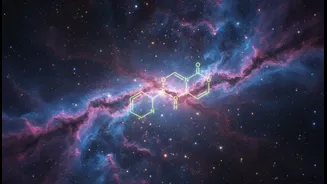
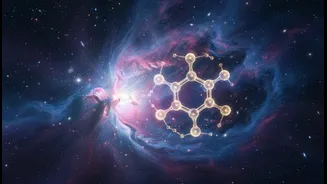
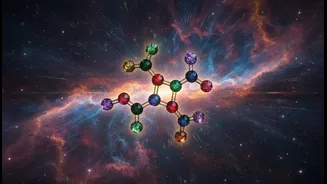
In a landmark discovery, an international team of astronomers has detected a true sugar molecule in interstellar space for the very first time. Using powerful radio telescopes in Spain, they identified erythrulose, a four-carbon sugar, in a vast molecular
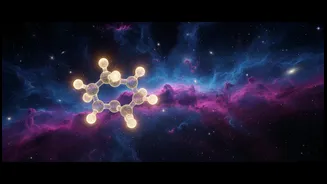
cloud named G+0.693−0.027. Located near the turbulent center of our Milky Way galaxy, this region is a known chemical factory, rich in complex molecules. While on Earth erythrulose is a simple sugar found in red raspberries, finding it floating in a gas cloud 26,000 light-years away is a monumental achievement. To make the detection, scientists scanned the cloud for specific radio frequencies emitted by molecules as they tumble in space. They found 12 distinct spectral lines that perfectly matched the unique fingerprint of erythrulose.
More Than Just Sugar
This isn't the kind of sugar you'd stir into your coffee. Molecules like erythrulose are known as prebiotic molecules—the chemical precursors to life. Sugars are fundamentally important for life as we know it; they provide energy and, crucially, form the structural backbone of RNA and DNA, the molecules that carry our genetic code. For decades, scientists have wondered if these essential ingredients formed on early Earth or if they were delivered from space. While other key molecules and even simpler sugar-like compounds like glycolaldehyde have been found in space before, this is the first direct detection of a true sugar in the interstellar medium. The discovery of erythrulose confirms that complex organic chemistry can happen in the cold, sparse environment between stars, long before planets even form.
An Unexpected Abundance
What surprised scientists most was not just that the sugar was present, but how much of it there was. The team found that erythrulose is at least eight times more abundant than simpler, three-carbon sugars, which were not detected at all in the same region. This discovery challenges long-held theories that complex molecules in space form incrementally, by adding one carbon atom at a time. The high concentration of a four-carbon sugar suggests that more complex formation pathways might be at play, perhaps with smaller molecules combining on the surfaces of icy dust grains. This finding hints that the universe may be even more efficient at creating the building blocks of life than previously imagined.
Seeding a Young Planet
The discovery has major implications for understanding how life began on Earth. While sugars like ribose (a key component of RNA) have been found in meteorites that have fallen to Earth, this new finding pushes their origins back further, into the interstellar clouds where stars and planets are born. Scientists theorize that during Earth's early, violent history—a period known as the Late Heavy Bombardment—comets and asteroids could have delivered millions of tonnes of these space-formed sugars to our planet's surface. This cosmic delivery could have provided the rich inventory of raw materials necessary to kickstart the first biological processes, forming a primordial soup from which life could emerge. It suggests the ingredients for life weren't unique to Earth but are common cosmic commodities.
What Comes Next?
This discovery is a watershed moment for astrobiology, the study of life's origins and its potential existence elsewhere. It proves that the chemical pathways to life exist far beyond our world. According to the research team, finding erythrulose opens the door to discovering other, even more biologically relevant sugars in space, like the ribose that forms RNA. Future observations with advanced telescopes will continue to scan these cosmic nurseries for more complex molecules. Each new detection brings us closer to understanding whether the emergence of life on Earth was a one-off miracle or an expected outcome of a chemically rich and ready universe.