





The Orbital Junkyard
Low Earth Orbit is becoming a hazardous place. Decades of space activity have left a legacy of clutter: thousands of dead satellites, spent rocket stages, and millions of smaller debris fragments. Travelling at speeds of thousands of kilometres per hour,
even a small object can cause catastrophic damage to an operational satellite, potentially knocking out communications, navigation, or scientific instruments. This orbital junkyard not only threatens current and future space missions but also raises the risk of a chain reaction, known as the Kessler syndrome, where collisions create more debris, leading to more collisions. Regulators like the US Federal Communications Commission (FCC) and the European Space Agency (ESA) are now mandating stricter rules for deorbiting satellites at the end of their life, driving the need for reliable cleanup technologies.
A Magnetic Handshake
Removing a defunct, and often tumbling, satellite is a delicate and risky operation. Methods like nets and harpoons are being tested, but they risk creating more debris if the capture isn't perfect. This is where magnetic grappling offers a more elegant solution. The concept is simple: a 'chaser' spacecraft equipped with a powerful electromagnet approaches a target satellite. Instead of a physical grab, it establishes a magnetic link. This can be achieved in two main ways. For future satellites, it involves attaching a simple ferromagnetic 'docking plate' before launch, providing an easy target for a magnetic probe to latch onto. Companies like Japan's Astroscale have already demonstrated this technology in orbit with their ELSA-d mission.
Contactless Capture for Older Satellites
But what about the thousands of satellites already in orbit that weren't designed to be captured? Many of them have components that can be manipulated by magnetic fields. A number of satellites use 'magnetorquers'—essentially electromagnets—to orient themselves using Earth's magnetic field. A powerful chaser spacecraft could use its own magnetic field to interact with these systems from a safe distance of 10-15 metres, gently stabilising the satellite's tumble and establishing control without ever making physical contact. Researchers are also exploring how rotating magnetic fields can induce electrical currents (eddy currents) in any conductive object, like a satellite's aluminium body, temporarily turning it into an electromagnet that can be maneuvered.
The Final Descent
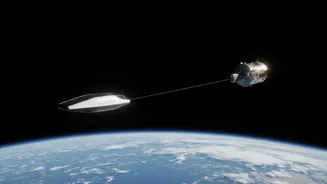
Once the magnetic probe has a secure lock on the defunct satellite, the mission enters its final phase. The chaser spacecraft, now acting as a space tug, uses its own propulsion system to guide the combined pair out of their orbit. This controlled descent is crucial. The goal is to steer the satellite towards a safe atmospheric re-entry, a process often referred to as 'design for demise'. The immense heat and friction generated upon entering the atmosphere are designed to cause the satellite to completely disintegrate and burn up, posing no threat to people on the ground. By targeting the re-entry over vast, unpopulated areas of the ocean, operators can ensure an exceptionally high degree of safety.
A Growing Business in a Crowded Sky
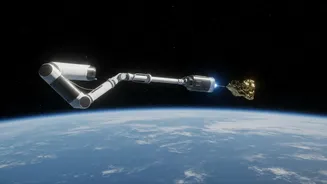
Magnetic capture is a key part of a broader, emerging market for on-orbit servicing and debris removal. The technology isn't just for disposal; it could also be used for refueling, repairing, or relocating satellites, extending their operational lives and maximizing their value. While magnetic solutions show great promise, they are part of a toolkit that includes robotic arms, nets, and harpoons, as each method has its own strengths depending on the target satellite's condition and design. As new regulations push for a cleaner space environment and satellite constellations continue to grow, the business of keeping our orbits safe and sustainable is set to become an essential part of the space economy.