



The Universe's Tiniest Clues
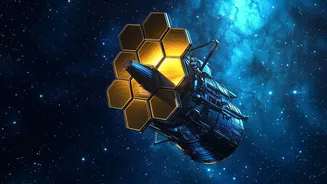
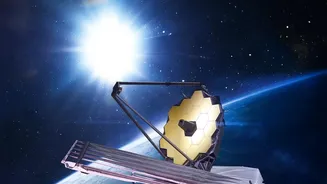
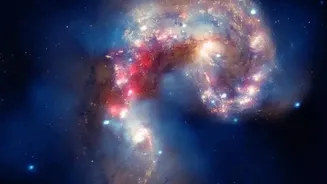
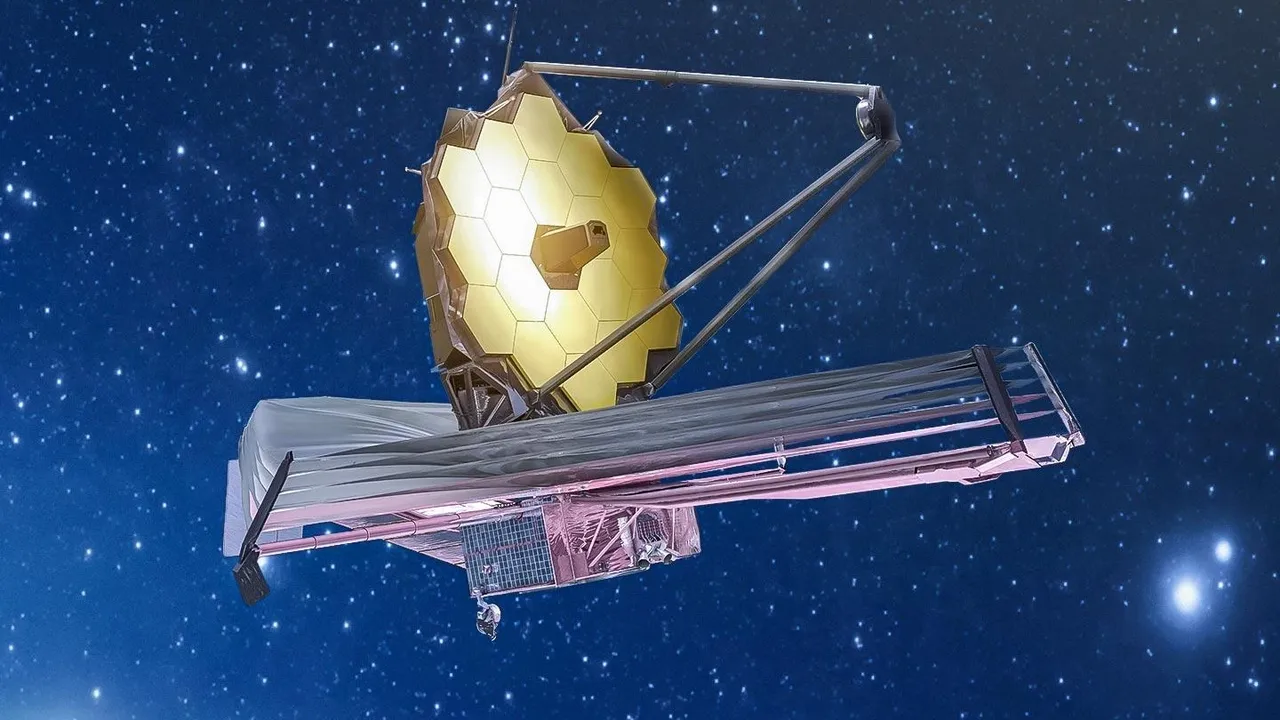
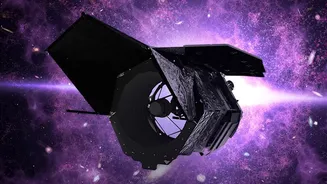
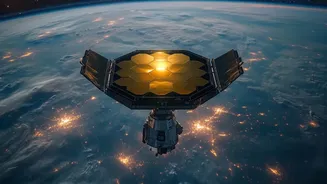
Since it began science operations, the James Webb Space Telescope (JWST) has been peering back to the dawn of time, capturing light that has traveled for over 13 billion years. Amidst the swirling galaxies in these images, a new class of object emerged:
small, compact, and very red sources that scientists nicknamed "Little Red Dots" or LRDs. These dots were surprisingly abundant in the early universe, appearing just a few hundred million years after the Big Bang, but they seemed to vanish as the cosmos aged. This presented a cosmic puzzle: what were these objects, and where did they go? Early theories suggested they could be incredibly dense, dusty young galaxies, but another, more radical idea was brewing.
Why Distance is the Key
In astronomy, looking across vast distances is the same as looking back in time. Because light travels at a finite speed, the light from an object 13 billion light-years away shows us what that object looked like 13 billion years ago. To confirm they were truly seeing the infant universe, astronomers needed to measure the extreme distance to these LRDs. They do this by measuring "redshift." As the universe expands, it stretches the wavelength of light traveling through it, shifting it towards the red end of the spectrum. The greater the redshift, the farther away and older the object is. Using its powerful Near-Infrared Spectrograph (NIRSpec), Webb confirmed that many LRDs had enormous redshifts, placing them firmly in the universe's first billion years.
A Surprising Revelation
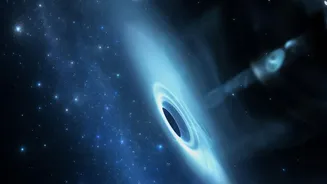
The data from Webb revealed something shocking. The light signatures from many of these LRDs were not consistent with just stars. Instead, they showed signs of intensely hot, fast-moving gas—a key indicator of an active galactic nucleus (AGN), which is a supermassive black hole actively feeding on surrounding material. One study in late 2025 confirmed an actively growing supermassive black hole in a galaxy just 570 million years after the Big Bang. Further studies in 2026 provided even clearer evidence, finding black holes that were astonishingly massive for their small host galaxies. In one case, the black hole was estimated to make up at least two-thirds of its host's total mass, a proportion thousands of times greater than what is seen in galaxies today.
Rewriting the Cosmic Storybook
These findings are forcing a major rethink of cosmic evolution. The long-held belief was that galaxies formed first and their central black holes grew along with them over billions of years. But the existence of these 'overmassive' black holes so early in time suggests that, in many cases, the black holes may have come first or grown much faster than their host galaxies. It appears that some supermassive black holes were either born enormous or grew at a furious pace in the cosmic dawn, challenging all existing models. This discovery helps explain how the gigantic, luminous quasars we see in the more mature universe came to be. They likely evolved from these extremely active, compact beginnings.
Solving the Disappearing Act
So, what happened to all the Little Red Dots? A very recent study published in July 2026 proposes a fascinating solution. Astronomers studied a more recent spiral galaxy nicknamed "Saguaro" that has a compact, red, LRD-like core. When they digitally simulated what this galaxy would look like at an extreme distance, its sprawling spiral arms vanished from view, leaving only the bright, red center—just like a Little Red Dot. This suggests LRDs may not be a unique type of object that disappeared, but rather a temporary, super-active phase in the life of a young galaxy. From our incredible distance, we can only see their brilliantly active cores, while the rest of their developing galaxy remains too faint for even Webb to detect. The dots never vanished; they simply grew into the kinds of galaxies we see today.