
Seeing the Bigger Picture
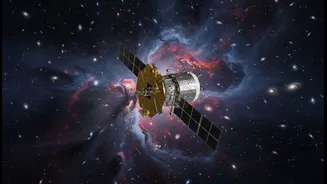
Imagine looking at the night sky. Telescopes like Hubble and Webb have given us breathtaking, deep looks into tiny patches of that sky, like peeking through a keyhole to see incredible detail. Now, imagine a telescope that can throw open a massive window
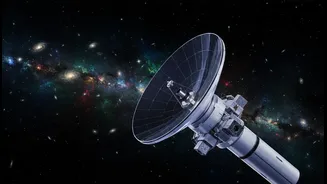
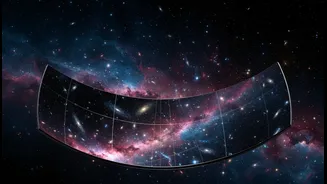
on the universe. That’s the Nancy Grace Roman Space Telescope. At its heart is the concept of “wide-field” astronomy. Instead of focusing on single, specific targets, Roman is designed to capture enormous swathes of the sky in a single shot. Its Wide Field Instrument (WFI) has a field of view 100 to 200 times larger than Hubble's infrared camera. This means that for every one image Hubble took, Roman can capture a vast mosaic, giving astronomers a panoramic vista without sacrificing the sharp, high-resolution quality we expect from a space observatory. This capability to see both the forest and the trees is what makes Roman a true powerhouse.
An Engine for Cosmic Discovery
The sheer efficiency of the Roman mission is staggering. With its 2.4-meter mirror—the same size as Hubble's—and its 300-megapixel camera, Roman is projected to map the sky up to 1,000 times faster than its illustrious predecessor. In just 63 days of observation, Roman will be able to capture an area of the sky that would have taken Hubble 85 years to image. This isn't just a minor upgrade; it's a fundamental shift in how astronomy can be done. While Webb is designed to peer into the deepest, earliest moments of the universe with its specialized infrared vision, Roman's strength lies in its breadth. It will conduct massive surveys, creating unprecedented maps of the cosmos that will serve as a foundational dataset for scientists for decades to come. Roman will identify countless new targets—from distant galaxies to nearby exoplanets—that more focused telescopes like Webb can then study in greater detail, making them perfect complements.
Illuminating the Universe's Dark Side
Two of the biggest mysteries in cosmology are dark energy and dark matter. We know they dominate the universe, but we know very little about them. Roman's primary mission is to tackle these questions head-on. One of its core tasks is a massive High-Latitude Wide-Area Survey, which will map hundreds of millions of galaxies and thousands of exploding stars, called Type Ia supernovae. These supernovae act as 'standard candles,' allowing astronomers to measure cosmic distances with incredible precision. By mapping their locations and how fast they are moving away from us, Roman will trace the expansion of the universe over billions of years, providing data ten times more precise than current measurements. This will help scientists understand the nature of dark energy—the mysterious force causing the universe's expansion to accelerate—and whether its strength has changed over cosmic time.
A Census of a Billion Stars
Beyond cosmology, Roman is set to revolutionize the hunt for exoplanets. While missions like Kepler found thousands of planets using the 'transit' method (watching for a star's light to dim as a planet passes in front), Roman will primarily use a different technique called gravitational microlensing. This method relies on the warping of spacetime caused by massive objects, as predicted by Einstein. When a star and its planet pass in front of a more distant star, their gravity acts like a lens, briefly magnifying the background star's light. Roman will monitor hundreds of millions of stars toward the center of our galaxy, looking for these tell-tale flickers. Microlensing is uniquely sensitive to planets that other methods miss: worlds farther from their stars, similar to Jupiter or Saturn, and even free-floating 'rogue' planets not tied to any star. Roman is expected to discover thousands of new worlds, providing the first comprehensive census of planets in our galaxy.