



A Ghost Particle Arrives
In September 2021, a high-energy neutrino slammed into the ice at the South Pole, tripping the sensors of the IceCube Neutrino Observatory. Neutrinos are fundamental particles, often called 'ghost particles' because they have almost no mass and no electric
charge, allowing them to pass through planets, stars, and entire galaxies without a trace. This ghostly nature makes them pristine messengers from the most violent events in the cosmos. But it also makes them incredibly difficult to trace. For years, scientists have been working to pinpoint the origins of these high-energy visitors, a field known as particle astronomy. Finding the source of a single neutrino is like trying to find which of a billion thunderstorms produced a single drop of rain. Yet, this particular neutrino, catalogued as IC 210922A, carried enough energy and information for astronomers to narrow its arrival direction to a small patch of sky.
Using Nature's Telescope
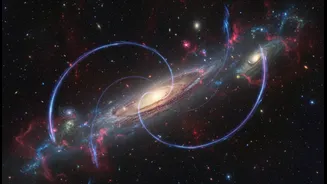
The key to solving this puzzle was a phenomenon predicted by Albert Einstein: gravitational lensing. According to his theory of general relativity, massive objects like galaxies warp the fabric of spacetime around them. When light—or any particle, including a neutrino—from a distant object passes by this massive foreground object, its path is bent. This can magnify, distort, and even create multiple images of the background source, acting as a natural cosmic telescope. In this case, astronomers using an array of telescopes, including the Atacama Large Millimeter/submillimeter Array (ALMA), noticed that a foreground galaxy was perfectly aligned to lens an even more distant object located right in the neutrino's suspected path. This cosmic magnifying glass amplified the distant source's brightness by more than ten times, making it possible to study in unprecedented detail.
Introducing the 'Shadow Blaster'
The source revealed by the gravitational lens was an ancient galaxy, seen as it was nearly 11 billion years ago. Officially known as JCMT0402−0424, it was so enshrouded in thick cosmic dust that it was nearly invisible in optical light. Because it was hidden in shadow yet blasting out energy at other wavelengths, astronomers nicknamed it the 'Shadow Blaster'. The lensing effect split its image into four distorted arcs of light, a classic signature that confirmed astronomers were looking at a distant object magnified by a cosmic heavyweight. Without this stroke of luck, the Shadow Blaster and its secrets would have likely remained hidden from our best instruments. The lens effectively gave scientists a powerful zoom function they could never build on Earth.
An Unexpected Cosmic Engine
The real surprise came when scientists analyzed what was powering the Shadow Blaster. Previously, the few high-energy neutrinos traced to their source came from blazars—galaxies with supermassive black holes at their cores that shoot out powerful jets of particles. The team fully expected to find another one. But the Shadow Blaster showed no evidence of a dominant black hole. Instead, the data pointed to a different kind of engine: an incredibly intense and compact region of star formation, known as a 'starburst'. In a dense core only about 1,500 light-years across, new stars were being born at a furious rate, creating a chaotic, high-energy environment. This cosmic nursery was acting as a natural particle accelerator, where collisions were energetic enough to forge the high-energy neutrino that travelled all the way to Earth.
A New Chapter in Particle Astronomy
This discovery is more than just finding one source; it potentially identifies a whole new class of neutrino factories. The era when the Shadow Blaster existed, known as 'Cosmic Noon', was when star formation peaked across the universe. Galaxies like it—dusty, compact, and furiously building stars—were common. While each individual starburst galaxy might not be a powerful neutrino emitter, their sheer numbers suggest they could collectively be responsible for a significant fraction of the high-energy neutrino background that observatories like IceCube detect. This finding provides the first solid observational link between a high-energy neutrino and a dusty starburst galaxy, shifting our understanding of where the universe's most energetic particles come from. It shows that to understand the high-energy universe, we need to look not just at monstrous black holes, but also at the universe's most prolific stellar nurseries.