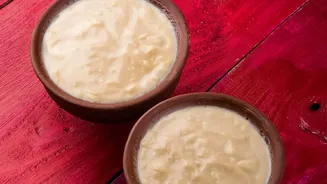






There’s nothing quite like a bowl of fresh, homemade curd. But sometimes, that creamy delight develops a sharp, tangy taste. This isn’t a sign of spoilage, but a natural process. Let’s dive into the fascinating science behind it.
The Magic of Fermentation
At its heart, making curd
is an act of controlled fermentation. The process begins when you introduce a 'starter'—a small amount of existing curd—into lukewarm milk. This starter is packed with millions of live microorganisms, specifically beneficial bacteria. These bacteria are the tiny chefs that transform liquid milk into the thick, wobbly curd we love. They kickstart a chemical reaction that changes the milk's entire structure and flavour profile.
Meet the Bacterial Workforce
The primary bacteria responsible for making curd, or dahi, belong to a group called Lactic Acid Bacteria (LAB). Species like Lactobacillus are the stars of the show. When added to milk, their main goal is to multiply. To get the energy to do so, they need to feed on the natural sugar present in milk, which is called lactose. Think of them as a microscopic workforce that gets busy as soon as they are introduced to their food source.
The Source of the Tanginess
So, where does the tangy flavour come from? It's the direct result of the bacteria's work. As the Lactobacillus bacteria consume lactose, they produce a byproduct: lactic acid. This is the key to both the texture and the taste of curd. The increasing amount of lactic acid lowers the milk's pH, making it more acidic. This acidity causes the milk's main protein, casein, to curdle and thicken, forming the solid mass of curd. The lactic acid itself has a distinct sour taste, which is what gives curd its characteristic tang.
Why Time and Temperature Matter
The level of tanginess is not fixed; it’s a dynamic process influenced heavily by time and temperature. The bacteria work faster in warmer environments. In the hot Indian summer, curd can set in just four to five hours, compared to eight or more in the winter. If you leave the curd to set for too long at room temperature, the bacteria don't just stop once it looks set. They continue to ferment lactose and produce more lactic acid, leading to an increasingly sour flavour. This is known as over-fermentation.
Tips for Perfectly Mild Curd
The good news is that you can control the tanginess. First, use less starter in warmer weather; about half a teaspoon for 500 ml of milk is often enough. Second, pay attention to the setting time. In summer, check your curd after four hours. As soon as it’s set, even if it’s a little soft, move it to the refrigerator immediately. Chilling the curd dramatically slows down the bacterial activity, effectively pausing the production of more lactic acid. Also, always use a clean, dry container to avoid introducing unwanted microbes that could affect the flavour.
Embracing the Sourness
While many prefer a mild curd for direct consumption, a tangier, sour curd (khatta dahi) is not spoiled and is highly valued in Indian cooking. Its sharp flavour is perfect for making dishes like kadhi, where the sourness provides a foundational taste. It's also an excellent ingredient for marinades, as the acidity helps to tenderise meat, and it can be used to make refreshing chaas or buttermilk. So, if your curd does become a little too tangy, don't throw it away; simply use it where its flavour can truly shine.