
A Messenger From Another Star
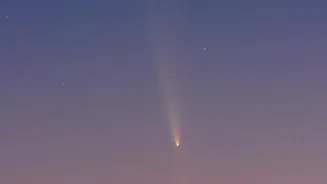
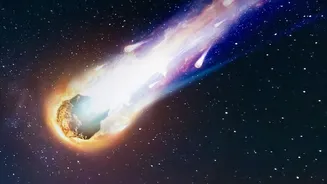
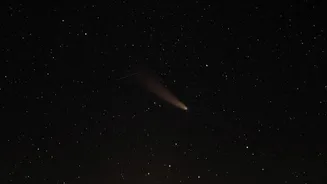
Our solar system is occasionally visited by objects that were born around other stars. These interstellar visitors are ejected from their home systems and travel for millions of years through deep space. On July 1, 2025, astronomers discovered the third
such object: a comet named 3I/ATLAS. The '3I' in its name signifies it as the third interstellar object found, following 1I/'Oumuamua in 2017 and 2I/Borisov in 2019. These travelers are incredibly valuable because they are, in essence, free samples from other planetary systems, offering us a chance to study alien building blocks up close. Unlike our own comets, which are locked in orbit around the Sun, these objects are on a one-way trip, moving too fast to be captured by the Sun's gravity.
Reading the Cosmic Chemical Code
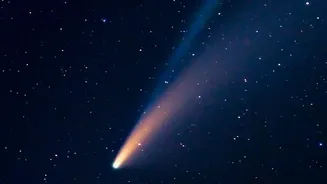
By studying the light from 3I/ATLAS, scientists can decipher its chemical makeup. Comets are like dirty snowballs made of ice, dust, and frozen gases left over from when planets formed. When a comet gets close to the Sun, these ices turn into gas, forming a glowing cloud called a coma. Observations of 3I/ATLAS revealed a composition that is startlingly different from our local comets. It is unusually rich in carbon dioxide (CO2) and methane. One study noted that 2I/Borisov, the previous interstellar comet, also had a high concentration of carbon monoxide. These chemical fingerprints suggest 3I/ATLAS formed in a very different environment than the comets in our own Oort cloud, providing clues about the variety of planetary nurseries across the galaxy.
Comparing Planetary Blueprints
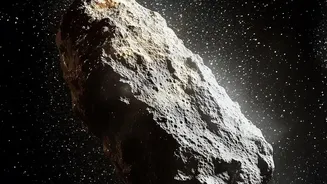
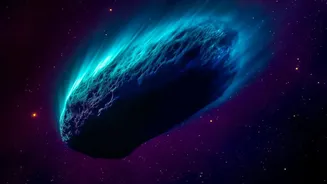
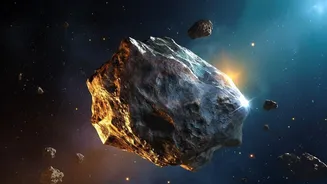
Every interstellar object is a new data point in a vast comparative study. The first visitor, 'Oumuamua, was bizarre—a rocky, cigar-shaped object with no visible coma, which puzzled scientists. The second, 2I/Borisov, looked much more like a conventional comet, though with its own unique chemical makeup. 3I/ATLAS adds another piece to the puzzle, showing that the building blocks of planets can vary significantly from one star system to another. By analyzing these differences, astronomers can refine their models of how planets form. Are the conditions that led to Earth common or rare? Studying these messengers helps us understand our own solar system's place in the cosmic order and how planetary systems evolve across the galaxy.
A Glimpse of the Primordial Past
Some analyses suggest that 3I/ATLAS could be incredibly ancient, perhaps having formed much earlier in our galaxy's history. If so, it would be an undisturbed relic from a time when the universe had a different chemical composition, with fewer heavy elements. Studying such a primordial object is like opening a time capsule from the young galaxy. Its long journey through interstellar space also tells a story. The reddish, carbon-rich material on its surface is thought to be the result of billions of years of bombardment by cosmic rays, which alters the original composition of its outer layers. As it gets closer to the Sun, these outer layers are shed, potentially revealing more pristine material from its core.
The Dawn of a New Era
For a long time, finding interstellar objects was a matter of pure luck. 'Oumuamua and Borisov were groundbreaking discoveries, but astronomers expect to see many more soon. New observatories, like the Vera C. Rubin Observatory in Chile, are set to revolutionize the field. This powerful new telescope will scan the entire sky every few nights, capable of detecting dozens of these faint, fast-moving visitors each year. In fact, a look back at early data showed the Rubin Observatory had unknowingly imaged 3I/ATLAS even before its official discovery was announced. We are moving from an era of rare, chance encounters to one of systematic study, where a steady stream of interstellar guests will provide a wealth of data about the cosmos.