


A Tale of Two 'Days'
The secret to this mind-bending fact lies in what we mean by a 'day'. When we talk about a day on Earth, we usually mean one cycle of sunrise and sunset. That’s called a 'solar day'. But there's another kind: a 'sidereal day', which is the time it takes
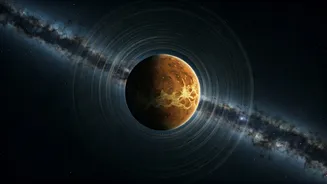
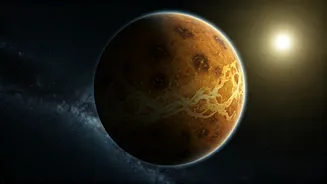
for a planet to complete one full 360-degree rotation on its axis, measured against distant stars. For the headline to be true, we must look at Venus's sidereal day. This is the time it takes for the planet to spin once. And Venus is an incredibly slow spinner. [14]
The Venusian Calendar
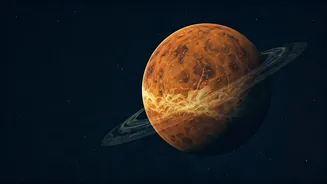
Let's start with the easy part: the year. A year is the time it takes for a planet to complete one full orbit around the Sun. Venus is closer to the Sun than Earth, so its journey is shorter. It zips around the Sun in just under 225 Earth days. [7] So, a Venusian year is roughly 61.5% as long as an Earth year. [10] If you were celebrating your birthday on Venus, you'd be having a party every 225 days. Simple enough. But this is where the simplicity ends and the weirdness begins.
The Day That Never Ends
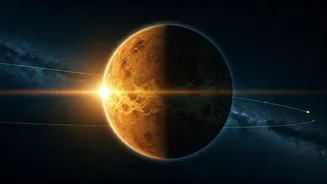
Venus's rotation is extraordinarily sluggish. It takes about 243 Earth days to complete a single sidereal rotation. [7, 9, 10] So, a single spin (a sidereal day) at 243 Earth days is indeed longer than its orbit around the Sun (a year) at 225 Earth days. [7] To make things even stranger, a solar day on Venus—the time from one sunrise to the next—is much shorter, at around 117 Earth days. [5, 8] This happens because the planet rotates backwards relative to its orbit. This means that in one Venusian year, the sun rises and sets only twice. [7, 10]
Why the Slow, Backward Spin?
So why is Venus so different from Earth and most other planets? Scientists have a couple of leading theories. One popular idea is that early in its history, Venus was struck by a massive object, a planet-sized body, that was powerful enough to not just slow its spin but completely flip it upside down, causing its 'retrograde' or backward rotation. [8, 9, 15] Another theory suggests its incredibly thick atmosphere is to blame. The dense, fast-moving atmosphere may create a powerful tidal effect that drags on the planet's surface, slowing its rotation over billions of years and fighting against the Sun's gravitational pull. [11, 13, 16] This atmospheric drag could be strong enough to have braked the planet's spin and even reversed it. [11, 13]
A Truly Alien Experience
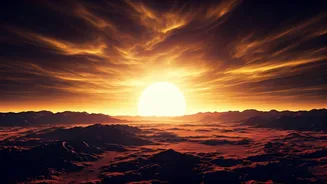
This slow, backward rotation contributes to Venus being one of the most hostile environments in the solar system. The surface is a crushing, scorching hellscape. Temperatures average a lead-melting 464 degrees Celsius, hotter than Mercury, which is closer to the Sun. [3, 4, 6] This intense heat is the result of a runaway greenhouse effect, where its thick, carbon-dioxide-rich atmosphere traps heat. [3] The atmospheric pressure is over 90 times that of Earth's, equivalent to being nearly a kilometre underwater. [2, 6] If you could survive standing on the surface, you would see the Sun rise slowly in the west and set in the east, after a day that lasts nearly two Earth months. [7, 11]