




A Glimpse Across the Cosmos
In a series of groundbreaking observations, astronomers have detected the unmistakable chemical signature of water vapour in the atmospheres of several exoplanets — planets orbiting stars other than our Sun. Using the unparalleled power of instruments
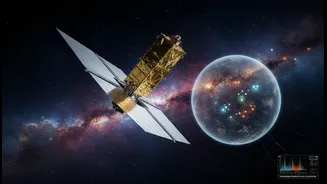
like the James Webb Space Telescope (JWST), scientists are revolutionising our understanding of these faraway worlds. Recent studies, including a new look at planets like the 'sub-Neptune' TOI-270 d, confirm that the technology to probe alien skies is not just a theory, but a reality. This doesn't just confirm the presence of water, but it opens a new chapter in the exploration of the galaxy.
How to Read an Alien Sky
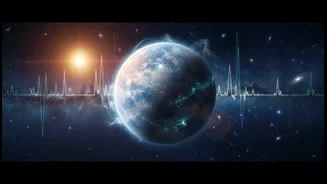
So, how exactly do scientists find water on a planet they can't even see directly? The primary method is called transit spectroscopy. When an exoplanet passes in front of its host star from our point of view, a tiny fraction of the starlight filters through the planet's atmosphere. Molecules in that atmosphere, like water vapour, absorb specific wavelengths, or colours, of light. By capturing the spectrum of the star before and during this transit, astronomers can identify what is missing. These missing slivers of light are the telltale fingerprints of the chemicals present, allowing them to determine the atmospheric composition from across vast cosmic distances. The JWST's sensitive infrared instruments are perfectly tuned to detect the signature of water.
More Than Just 'Is There Water?'
Finding water is incredibly exciting, but its presence is just the first clue in a much larger detective story. The amount of water, and its interplay with other detected molecules like methane and carbon dioxide, can help scientists paint a picture of the planet's climate and history. For example, recent studies have shown that on some planets, the water detected in the upper atmosphere might only be a fraction of what is hidden deeper inside. Understanding these chemical inventories helps scientists build models about how these planets formed — whether they were born in their current orbit or migrated from elsewhere in their solar system, perhaps collecting ice and other materials along the way.
The Quest for Habitable Worlds
The ultimate goal behind this atmospheric detective work is the search for habitable environments. The presence of water vapour is a critical piece of the puzzle, as liquid water is essential for life as we know it. When astronomers find water vapour on a planet that also orbits within its star's 'habitable zone' — the region where temperatures could allow for liquid water on the surface — excitement builds. This doesn't automatically mean the planet is inhabited, or even that it has oceans. A thick, crushing atmosphere or intense radiation from its star could render it inhospitable. However, detecting water is a crucial first filter, narrowing down the list of candidates for worlds that could potentially support life.
The Next Frontier for Science
This is just the dawn of exoplanet atmospheric science. Every new detection provides a rich data set that challenges and refines our theories of planet formation and evolution. The discoveries made by JWST are part of a global scientific effort that includes contributions from space agencies and researchers worldwide, including India's own ambitions with the Indian Space Research Organisation (ISRO). As telescopes become more powerful and our analytical techniques more sophisticated, scientists will be able to paint increasingly detailed portraits of these distant worlds. The goal is to move from simply detecting water to mapping climates, identifying cloud cover, and searching for a combination of gases that could indicate biological processes — what scientists call a biosignature.