



From Disposable to Serviceable
For decades, the satellite industry has operated on a disposable model. A satellite, often costing hundreds of millions of dollars, is launched into orbit and operates until it runs out of fuel or a critical component fails. At that point, it becomes
another piece of space junk. This is not only wasteful but also increasingly risky. The region of Low Earth Orbit (LEO) is congested with over 100 million pieces of debris, posing a collision threat to the thousands of active satellites we rely on for communication, navigation, and climate monitoring. The economic loss associated with a single satellite failure can be immense, with studies quantifying the social cost of losing key satellites in the hundreds of millions of dollars over a decade. This growing risk and cost has created a powerful business case for a new approach: instead of replacing, why not repair, refuel, and upgrade?
The Pioneers of Orbital Repair
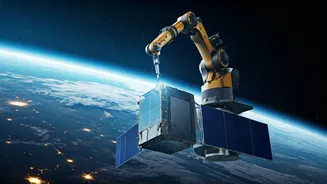
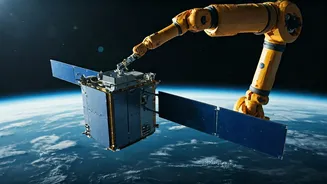
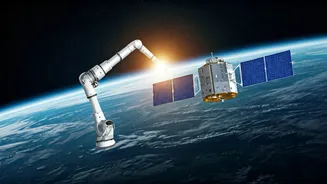
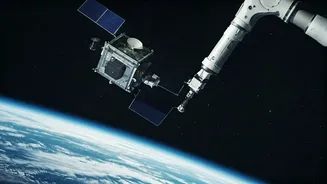
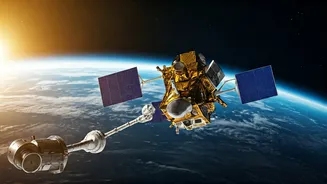
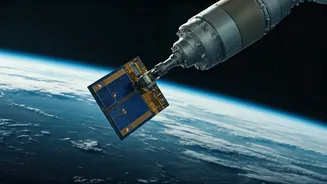
A new class of companies is rising to meet this demand, offering everything from simple life extension to active debris removal. Northrop Grumman has been a trailblazer with its Mission Extension Vehicle (MEV). The MEV-1 and MEV-2 spacecraft successfully docked with Intelsat satellites in 2020 and 2021, respectively, taking over propulsion and effectively giving them years of extra life. In April 2025, MEV-1 completed its five-year mission with one satellite and moved on to its next client, proving the commercial model's viability. Northrop is now developing a more advanced Mission Robotic Vehicle (MRV), equipped with robotic arms to perform repairs, inspections, and install jetpack-like Mission Extension Pods. Other companies like Astroscale are tackling the space junk problem head-on. Its ELSA-d mission demonstrated magnetic capture technology, and its ADRAS-J spacecraft successfully performed a close-proximity inspection of a large piece of debris. Astroscale is now preparing for a 2026 mission to demonstrate the removal of multiple defunct satellites.
A Market Driven by Necessity
The on-orbit servicing, assembly, and manufacturing (OSAM) market is projected to grow significantly, with some estimates predicting it will reach over USD 5.7 billion by 2032. This growth is driven by both commercial and government needs. For commercial satellite operators, extending the life of a multi-million dollar asset is a clear economic win. For government and military operators, the ability to maneuver, refuel, and repair satellites—known as dynamic space operations—is a critical strategic capability. The U.S. Space Force is actively funding this area, awarding significant contracts to companies like Starfish Space to develop servicing vehicles. This government backing acts as an important anchor for the burgeoning commercial market, validating the technology and providing initial customers. Several key missions are slated for 2026 to demonstrate refueling and other servicing capabilities, marking a transition from proof-of-concept to operational service.
A Real-World Rescue Mission
A dramatic example of this new capability is unfolding right now. NASA's Neil Gehrels Swift Observatory, a vital tool for studying gamma-ray bursts, is falling out of orbit faster than expected due to increased atmospheric drag. With no onboard propulsion, the satellite was facing a destructive re-entry. In a first-of-its-kind mission, NASA awarded a contract to the startup Katalyst Space to launch a robotic servicing spacecraft called LINK. Launched in early July 2026, LINK's mission is to rendezvous with Swift, grapple onto it, and slowly boost its orbit, extending its life by up to a decade. This mission is particularly challenging as Swift was never designed to be serviced in space. Its success would not only save a valuable scientific asset but also provide a powerful demonstration of the potential for commercial servicing to rescue and maintain critical space infrastructure.