




The Hidden Highway Inside Every Tree
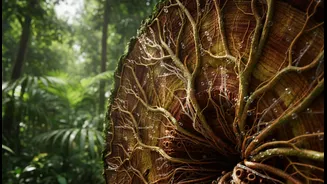
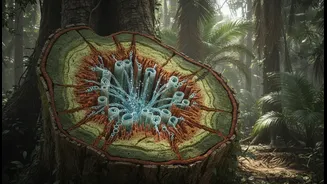
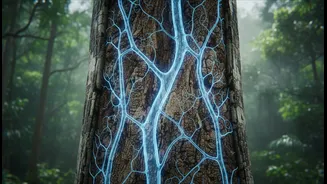
Think of a tree as a complex city. To keep everything running, it needs a sophisticated transport network. This is where its 'plumbing' comes in. Just beneath the bark lies a network of microscopic tubes. The xylem acts like a one-way highway, pulling
water and nutrients from the roots all the way up to the highest leaves. This gravity-defying feat is powered by a process called transpiration pull, where water evaporating from leaves effectively sucks more water up from below, like a person drinking through a very, very long straw. Running parallel is the phloem, a different set of tubes that distributes the sugary food produced during photosynthesis from the leaves to the rest of the tree. Together, this vascular system is the lifeline of the plant, crucial for everything from growth to simple survival.
When The Taps Run Dry: Water Stress
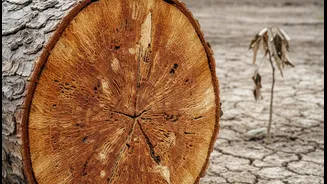
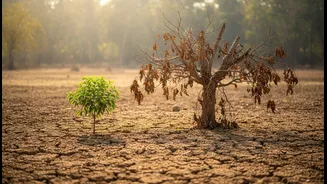
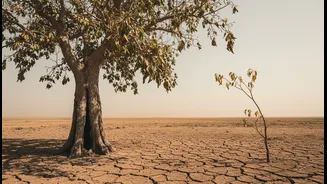
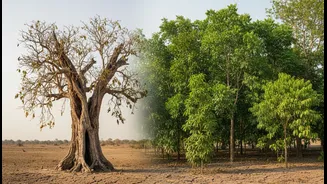
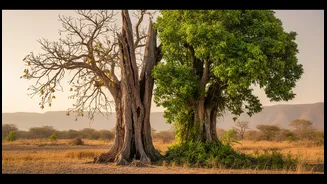
During a drought, the soil dries up and the tree's plumbing faces a crisis. As the tree continues to try and pull water from the parched earth, the tension in the xylem columns increases dramatically. This can lead to a catastrophic failure known as cavitation or an embolism—essentially, a tiny air bubble forms in a water-conducting tube. This bubble breaks the continuous column of water, blocking the flow like a clot in an artery. A few embolisms are manageable, but as drought worsens, more can form, effectively choking the tree and preventing water from reaching the leaves. This is the core of water stress. The leaves wilt, photosynthesis stops, and if the drought persists, the tree may die, not just from thirst, but from this internal hydraulic failure.
The Great Debate: Tall vs. Small
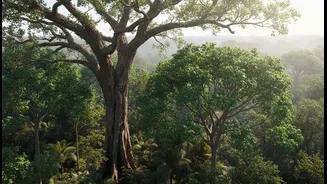
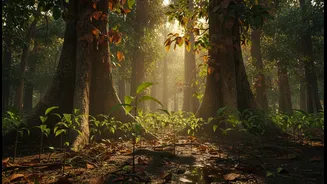
For a long time, scientists believed that the tallest trees were the most vulnerable to drought. The logic seemed simple: moving water over 70 metres into the air is an immense physical challenge, and the effects of gravity and friction should make them more susceptible to hydraulic failure. However, groundbreaking research from July 2026 has challenged this long-held assumption. Studies on giant tropical trees, such as the dipterocarps in Southeast Asia, show they have evolved remarkable adaptations. As they grow taller, their xylem vessels become wider at the base, acting like larger pipes that reduce resistance and allow for more efficient water flow. Furthermore, the leaves at the very top of these giants are adapted to function with less water, effectively rewiring their own expectations for hydration. As a result, during recent major droughts, these colossal trees were found to be no more vulnerable than their smaller neighbours.
A Forest's Strength Is in Its Diversity
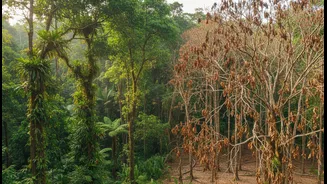
While an individual tree's plumbing is key to its own survival, the collective mix of these strategies is what determines the resilience of an entire forest. An ecosystem with high 'hydraulic diversity'—meaning it contains trees with many different water-use strategies—is better equipped to handle drought. Some species may close up their leaf pores (stomata) early to conserve water, while others risk keeping them open to continue photosynthesising. Some have deep taproots to access underground water, while others have shallow, sprawling systems. This variety acts as an insurance policy. If a drought is particularly severe and long, it might wipe out trees with riskier strategies, but the more conservative species will survive, allowing the forest to endure. A forest with only one type of plumbing is far more brittle.
Why This Matters for India's Forests
This science is not just academic; it's critical for India. From the Western Ghats to the central Indian highlands, vast tracts of tropical forest are facing rising temperatures and increasingly erratic rainfall. These forests are vital carbon sinks, regulators of regional climate, and home to immense biodiversity. Studies show that changing climate patterns are already putting pressure on these ecosystems, altering their composition and health. Understanding the hydraulic strategies of Indian tree species—which ones are risk-takers and which are conservatives—is crucial for predicting how these forests will respond to future droughts. This knowledge can guide conservation and restoration efforts, helping to build more resilient forests capable of weathering the climatic challenges ahead.