


Cosmic Beacons at the Dawn of Time
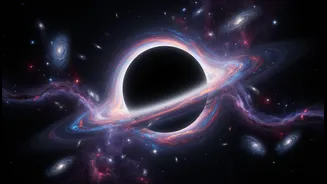
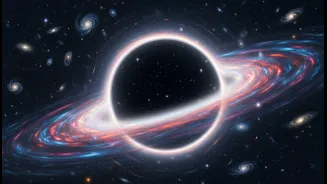
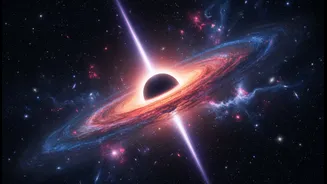
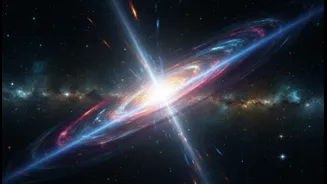
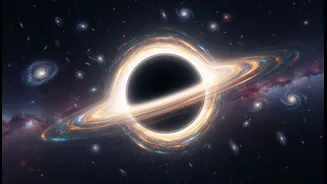
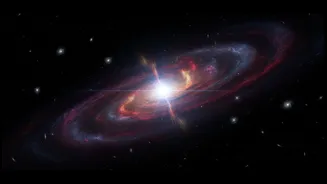
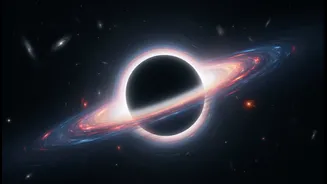
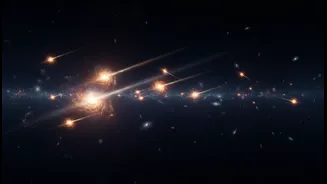
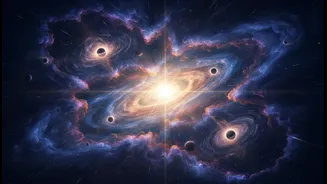
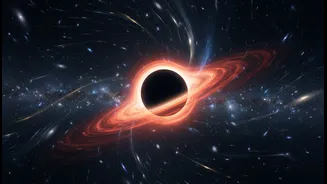
First, what even is a quasar? Imagine a supermassive black hole, millions or billions of times the mass of our sun, sitting at the center of a young galaxy. Now, imagine it having a feast. As it pulls in enormous amounts of gas and dust, the material
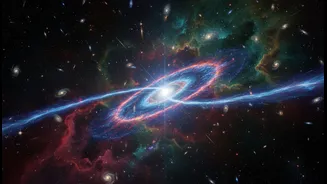
swirls into a disc, heats up to incredible temperatures, and shines with the brightness of a trillion suns. This blazing beacon is a quasar, and it's so intensely luminous it can be seen from across the universe, allowing us to glimpse the cosmic dawn.
The Standard Growth Plan for Black Holes
For decades, scientists had a solid theory for how these giants formed. It was a story of patient growth. A massive star dies, collapses, and forms a relatively small 'seed' black hole. Over billions of years, this seed grows by slowly accreting gas and by merging with other black holes when galaxies collide. This model works perfectly to explain the supermassive black holes we see in the nearby, modern universe. The key assumptions were that it takes time—a lot of it—and that a black hole's growth is tied to the growth of its host galaxy.
The 'Impossible' Giants
The problem is, new observations are finding black holes that break the rules. Telescopes like the Euclid and JWST are discovering quasars from a time when the universe was just 670 million years old—a mere 5% of its current age. These aren't small black holes, either. They are already monsters, weighing hundreds of millions to billions of times the mass of our sun. According to the standard growth model, there simply hasn't been enough time since the Big Bang for them to get that big. It's a major, unsolved problem for astrophysicists.
Too Big, Too Soon, Too Fast
The fundamental speed limit on black hole growth is known as the Eddington limit. Essentially, the brighter a quasar shines, the more radiation it blasts outwards. This radiation pushes back on the very gas the black hole is trying to eat, preventing it from feeding too quickly. The newly discovered ancient black holes would have needed to grow continuously at this maximum possible rate, without interruption, for the entire history of the universe up to that point. That scenario is physically unlikely. Some of these early black holes are also wildly out of proportion with their host galaxies, making up a huge percentage of the galaxy's total mass, unlike the tiny fraction seen in galaxies today.
Rewriting the Cosmic Rulebook
These findings are forcing scientists to get creative and challenge old assumptions. One idea is that the first black hole 'seeds' were much heavier than we thought. Instead of forming from a single star, perhaps vast clouds of gas in the early universe collapsed directly into black holes weighing tens of thousands of solar masses. Another possibility is that early black holes found ways to cheat the speed limit, engaging in short, intense bursts of 'super-Eddington' growth, gobbling up matter much faster than thought possible. The discoveries don't mean our models are wrong, but that they are incomplete, and these ancient quasars are providing the clues needed to fill in the gaps.