



More Than Just an Ancient Halo
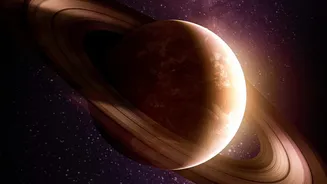
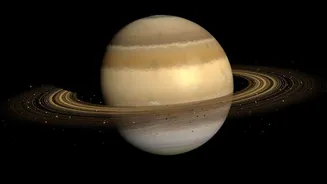
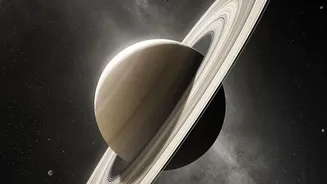
For centuries, we viewed Saturn's rings as a permanent fixture, likely formed at the same time as the planet itself, over four billion years ago. They appeared as a stable, unchanging disc of ice and rock. However, data gathered from NASA's Cassini mission,
which spent 13 years studying the Saturn system, has completely upended this idea. The evidence now points to the rings being a relatively recent addition, perhaps only 10 to 100 million years old. This means they may have formed while dinosaurs still roamed the Earth. This relative youth is deduced from their brightness; being made of over 95% water ice, they are surprisingly clean. Over billions of years, they would have been darkened by a constant influx of interplanetary dust, much like a snowbank getting dirty over a long winter. Their pristine condition suggests they simply haven't been around that long.
A Constant 'Ring Rain'
The most dramatic discovery is that the rings are actively disappearing. Scientists have confirmed a phenomenon first theorized in the 1980s called "ring rain." Saturn's immense gravity is constantly pulling particles from the rings down into the planet's upper atmosphere. This process is supercharged by Saturn's magnetic field, which funnels electrically charged icy particles along its field lines. The material, which includes not just water but also methane, carbon monoxide, and organic molecules, vaporizes as it enters the atmosphere. The sheer volume of this celestial shower is staggering; NASA estimates that an amount of water equivalent to an Olympic-sized swimming pool is drained from the rings every half hour.
The Violent Mechanics of Change
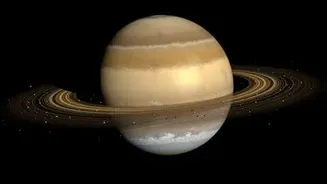
The rings are not a solid disc but a chaotic swarm of countless individual particles, ranging from the size of a dust grain to that of a mountain. This system is in constant flux, shaped by multiple forces. Micrometeoroid impacts continuously bombard the rings, kicking up debris. Furthermore, the moons orbiting within and near the rings act as gravitational shepherds, sculpting their structure and creating gaps. Cassini's final orbits, dubbed the 'Grand Finale,' took it into the unexplored region between the planet and its innermost ring. It made the surprising discovery that nanometer-sized dust from the D-ring was streaming into Saturn's atmosphere, a process different from the magnetic ring rain seen at higher latitudes. This constant loss of material reveals a system that is far from being in a state of equilibrium.
A Fleeting Cosmic Wonder
This dynamism has a profound implication: we are living in a special, fleeting moment in our solar system's history. Based on the rate of material loss from ring rain and other infall measured by Cassini, scientists estimate the rings have less than 100 million years left before they vanish entirely. While this sounds like a long time in human terms, it's a cosmic blink of an eye compared to Saturn's 4.5-billion-year existence. It suggests that for the vast majority of its life, Saturn had no rings. This discovery challenges our perception of planetary systems as static, reminding us that the cosmos is an ever-evolving place. The iconic rings are not a permanent feature, but a temporary spectacle we are incredibly fortunate to witness.