

Know When and Where to Look
Timing is everything. Throughout October 2026, Saturn is exceptionally well-positioned for viewing. The planet reaches 'opposition' on October 4th, meaning Earth is directly between Saturn and the Sun. This makes it visible all night long, rising in the east
around sunset and setting in the west around sunrise. It will appear as a bright, steady, yellowish point of light. Unlike stars, which twinkle due to atmospheric turbulence, planets shine with a more constant glow. Look towards the eastern sky after dark; Saturn will be located beneath the Great Square of Pegasus, a large, boxy pattern of stars.
Your Eyes Are the First Tool
You don’t need any equipment to spot Saturn. It’s the most distant planet from Earth that is still easily visible to the unaided human eye. To find it, first find a spot away from the direct glare of streetlights or porch lights. Once you locate the non-twinkling, golden 'star,' you have found Saturn. While you won't see its famous rings this way, simply identifying a planet that is over a billion kilometres away is a remarkable experience in itself. Give your eyes about 15-20 minutes to fully adapt to the darkness. This will dramatically increase your ability to see fainter objects.
Upgrade Your View with Binoculars
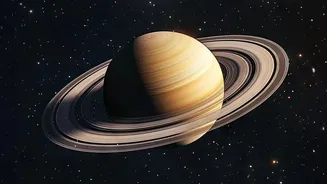
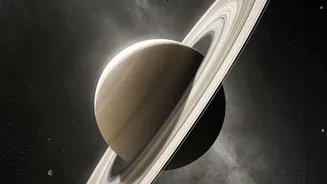
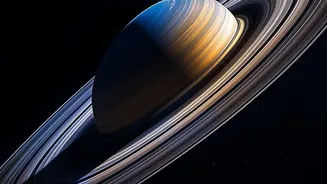
If you have a pair of binoculars—even a standard 7x50 or 10x50 set—you can elevate your viewing session. While they won't give you a Hubble-like image, they will reveal more than the naked eye. When you look at Saturn through binoculars, it will no longer be a simple point of light. Instead, you should be able to see it as a tiny, slightly flattened, or oval-shaped disc. That 'out-of-round' shape is caused by the rings! You won't see a gap between the planet and its rings, but you will notice it looks elongated, like a star with 'ears'. For the best results, try to steady your arms by leaning against a wall or a car.
Let Your Smartphone Be Your Guide
Your smartphone can be a powerful astronomical tool. There are numerous free or low-cost stargazing apps that use your phone's GPS and compass to create a real-time map of the sky. Apps like SkyView Lite, Stellarium Mobile, and Star Walk 2 are excellent for beginners. Simply point your phone towards the sky, and the app will identify stars, constellations, and, most importantly, planets like Saturn. Many of these apps have an augmented reality (AR) mode that overlays the celestial map onto your camera's view, making it incredibly easy to find your target. They also feature night modes with a red filter to help preserve your night vision.
Escape the City Glow
The biggest obstacle for any stargazing session is light pollution. The glow from city lights can wash out all but the brightest objects. While Saturn is bright enough to be seen from urban areas, finding a darker location will significantly improve your experience. You don’t necessarily need to drive for hours. A local park, a large field, or even a rooftop can offer a better vantage point by shielding you from direct streetlights. Apps like Light Pollution Map can help you find darker spots nearby. The key is to find a location with an unobstructed view of the sky, away from immediate, bright sources of light.
What to Expect and Enjoy
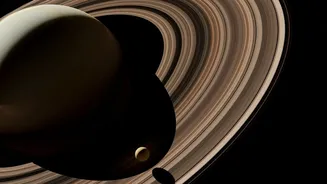
Managing expectations is crucial for a satisfying experience. With just your eyes and a basic pair of binoculars, you are participating in the same act of wonder that has captivated humans for millennia. You won't see a detailed, colourful planet, but you will see a real world floating in space. With a steady hand and good binoculars, you might even spot Saturn's largest moon, Titan, appearing as a faint star-like dot very close to the planet. The real reward is the personal connection to the cosmos—the knowledge that you are looking at an icy, ringed giant with your own eyes, confirming its place in our solar system.