


A Day Longer Than a Year
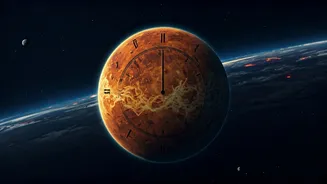
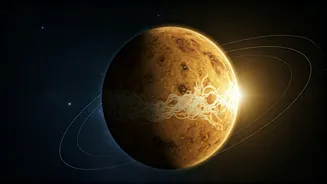
Let’s get the mind-bending numbers out of the way first. It takes Venus about 225 Earth days to complete one full orbit around the sun. That’s its year. Simple enough. But here’s the twist: it takes the planet a staggering 243 Earth days to complete a single
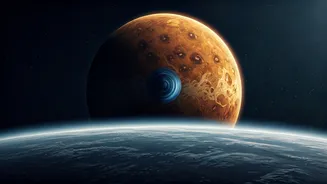
rotation on its axis. This rotation period is what astronomers call a 'sidereal day.' So, yes, the headline is true—a single day of rotation on Venus is 18 Earth days longer than its entire year. If you were standing on Venus, the planet would complete its trip around the sun before it finished spinning around just once. It’s the only planet in our solar system with this strange characteristic, making it a true astronomical oddity.
The Sunrise-to-Sunrise Twist
But wait, it gets even weirder. When we think of a 'day,' we usually mean the time from one sunrise to the next, which is called a 'solar day.' Because Venus rotates backward (retrograde motion) while orbiting the sun, these two movements work against each other in a strange way. Think of it like walking backward on a moving walkway. The combination of its slow, backward spin and its forward orbit means that the time between sunrises is actually shorter than its rotation period. One solar day on Venus lasts about 117 Earth days. This means you’d experience roughly two sunrises for every Venusian year. So, while a single spin takes forever, the 'day' as you'd experience it is long, but not *as* long as the year. It's a planetary puzzle where the definitions we take for granted on Earth completely fall apart.
What Put the Brakes on Venus?
Why is Venus so slow and backward? Scientists have a few compelling theories, but no single definitive answer. One leading hypothesis points to its incredibly thick, heavy atmosphere. The dense blanket of carbon dioxide, about 90 times thicker than Earth’s, is believed to create powerful atmospheric tides. Over billions of years, the gravitational pull of the sun on this massive atmosphere could have acted like a brake, slowing the planet’s rotation to its current crawl. Another, more dramatic theory suggests that early in its history, Venus was struck by a massive asteroid or protoplanet. Such a cataclysmic impact could have been powerful enough to not only halt its original spin but actually reverse it, leaving it with the slow, retrograde motion we see today. It’s possible a combination of these factors created the unique planetary treadmill Venus is on.
A World Forged by a Slow Spin
This sluggish rotation has profound consequences for the planet itself. On Earth, our relatively brisk 24-hour spin helps generate a protective magnetic field that shields us from harmful solar radiation. Venus, spinning at a glacial pace, has no such global magnetic field, leaving its upper atmosphere exposed to the solar wind. Furthermore, the long days and nights might suggest extreme temperature swings, but Venus's thick atmosphere acts like an insulating blanket. It traps heat so effectively that the entire surface remains a uniform, lead-melting 864°F (462°C), whether it's day or night. There’s no relief from the heat. This runaway greenhouse effect, combined with its bizarre rotation, makes Venus a fascinating but terrifying vision of a world gone wrong—and a crucial case study for understanding how planets evolve.