







Visas: Your Essential First Step
Before booking anything else, sort out your visas. For Indian passport holders, the process for both countries is straightforward and can be done online. For Vietnam, the recommended option is the e-visa, available through the official government portal.
As of 2026, this allows for a stay of up to 90 days. The application is entirely online, costs approximately $25-$50 USD depending on entry type, and typically takes 3-5 working days to process. For Cambodia, Indian citizens have two convenient choices: an e-visa or a visa on arrival. The e-visa can be applied for online before you travel for a fee of around $36 USD. Alternatively, you can get a visa on arrival at major international airports like Siem Reap and Phnom Penh for a fee of $30 USD, paid in cash. For the visa on arrival, you'll need a passport valid for at least six months and a passport-sized photograph.
Flights: Connecting Chennai to Southeast Asia
There are no direct flights from Chennai (MAA) to Vietnam or Cambodia, but numerous one-stop options make the journey manageable. Popular connecting hubs include Singapore, Kuala Lumpur, and Bangkok. Airlines like AirAsia, Singapore Airlines, and Thai Airways frequently operate these routes. When booking, consider flying into one country and out of the other to save time and avoid backtracking. A common route is to fly from Chennai to Ho Chi Minh City (SGN) in southern Vietnam and return from Siem Reap (SAI) in Cambodia. Flight prices can vary significantly, so booking a few months in advance is advisable to secure better fares. Expect the one-way journey, including layover, to take between 9 and 11 hours.
Crafting Your Itinerary: A Logical Route
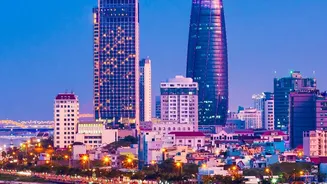
A well-planned itinerary is key to maximizing your time. A popular 10 to 14-day route starts in Vietnam and ends in Cambodia. You could begin in southern Vietnam's Ho Chi Minh City, exploring the Mekong Delta and Cu Chi Tunnels. From there, take a short domestic flight to Da Nang to visit the charming ancient town of Hoi An. Continue north to the capital, Hanoi, and take an overnight cruise in the stunning Halong Bay. From Hanoi, you can take a regional flight to Siem Reap, Cambodia, the gateway to the magnificent Angkor Wat temple complex. Spend a few days exploring the temples before heading to the capital, Phnom Penh, to understand its poignant history at the Royal Palace and Killing Fields. You can then fly back to Chennai from Phnom Penh.
Money Matters: Cash and Cards
Understanding the local currencies will make your trip smoother. Vietnam's currency is the Vietnamese Dong (VND), and while credit cards are accepted in major hotels and restaurants in cities, cash is essential for street food, local markets, and rural areas. In Cambodia, the official currency is the Cambodian Riel (KHR), but the US Dollar is widely used and accepted for almost everything, from hotel bills to tuk-tuk rides; you will often receive small change in Riel. It's advisable to carry a mix of cash (VND in Vietnam, and small denomination USD in Cambodia) and a credit or debit card. ATMs are widely available in cities in both countries, but it's a good idea to inform your bank about your travel plans to avoid any issues.
Accommodation and Local Transport
Both Vietnam and Cambodia offer a wide range of accommodation options to suit every budget, from backpacker hostels to luxurious resorts. Popular booking websites are a great place to find deals and read reviews. In terms of getting around, domestic flights are the most efficient way to cover long distances within Vietnam. For shorter journeys, overnight trains and buses are cost-effective options. In Cambodia, buses are the primary mode of transport between cities like Phnom Penh and Siem Reap. Within cities, ride-hailing apps like Grab are popular, affordable, and easy to use. For a local experience, don't hesitate to take a traditional cyclo or tuk-tuk for short distances.