


Understanding Your Core
Before you drop to the floor, it’s important to know what you’re working. Your core is much more than the 'six-pack' muscles (rectus abdominis). It’s a complex network of muscles that includes your deep abdominals, back muscles, diaphragm, pelvic floor, and
even your glutes. Together, these muscles work to stabilize your spine, protect your internal organs, and transfer force between your upper and lower body. A strong core is your body's central support system, essential for everything from walking down the street to performing complex athletic movements.
The Classic Plank
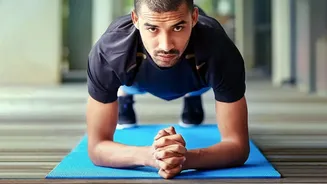
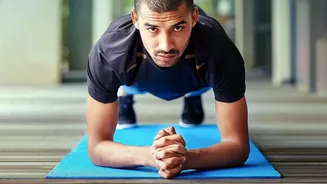
The plank is a fundamental exercise for a reason: it engages your entire core. To perform it correctly, start on your forearms and toes, with your elbows stacked directly under your shoulders. Your body should form a straight line from your head to your heels. Avoid common mistakes like letting your hips sag, which can strain your lower back, or raising your hips too high, which reduces the exercise's effectiveness. Engage your abdominals by imagining you are pulling your belly button towards your spine and squeeze your glutes. Focus on steady breathing and hold the position for as long as you can maintain good form.
The Dead Bug
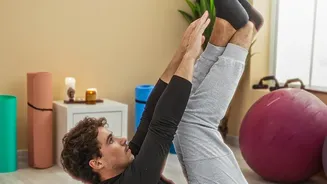
This exercise is excellent for developing coordination and stability while protecting your lower back. Lie on your back with your arms extended towards the ceiling and your legs in a tabletop position (knees and hips bent at 90 degrees). Press your lower back gently into the floor. Slowly lower your right arm and left leg toward the floor simultaneously, moving only as far as you can without your back arching. Return to the starting position with control and repeat on the other side. The key is slow, deliberate movement, not speed.
The Glute Bridge
Your glutes are a powerful part of your core, and the glute bridge is the perfect way to activate them. Lie on your back with your knees bent, feet flat on the floor about hip-width apart, and your arms at your sides. Squeeze your glutes and engage your abs to lift your hips off the floor until your body forms a straight line from your shoulders to your knees. Pause at the top, ensuring you feel the work in your glutes, not your lower back. Slowly lower your hips back to the starting position.
The Bird-Dog
The bird-dog challenges your stability by forcing your core to resist rotation. Start on all fours in a tabletop position, with your hands under your shoulders and your knees under your hips. Engage your core to keep your back flat and your torso stable. Extend your right arm straight forward and your left leg straight back, creating a straight line from your fingertips to your heel. The goal is to keep your hips and shoulders perfectly level, as if you were balancing a glass of water on your back. Hold for a moment before returning to the start and repeating on the other side.
Creating Your Routine
Consistency is more important than intensity. You don't need to spend hours to see results. Aim to perform these exercises 3-4 times per week. A simple starting routine could be to perform each exercise for 30-45 seconds (or 10-12 reps per side for alternating movements like the dead bug and bird-dog). Complete two to three rounds of the entire circuit, resting for a minute between rounds. As you get stronger, you can increase the hold times, add more reps, or reduce your rest periods. Focus on perfect form over everything else; it is better to do fewer reps correctly than many reps with poor technique.