

The Ultimate Insurance Policy in Spaceflight
Sending humans to space is an inherently risky endeavour. The most perilous phase is the launch, where the rocket is a controlled explosion propelling a spacecraft at immense speeds. If anything goes wrong—a loss of thrust, a structural failure, or a sudden
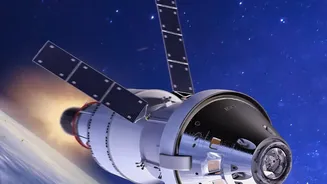
deviation from the flight path—the window to save the crew is measured in milliseconds. This is where the Crew Escape System (CES), often called an escape tower, comes in. It's the ultimate insurance policy, an astronaut's last and best hope in a launch-day catastrophe. The system is designed to do one thing with brutal efficiency: pull the crew module, the capsule housing the astronauts, away from the failing rocket and carry it to a safe distance before it can be harmed.
Anatomy of a High-Speed Rescue
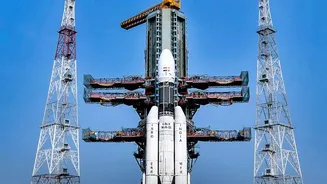
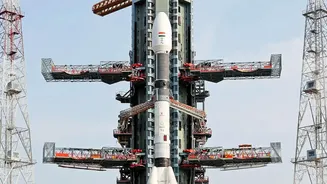
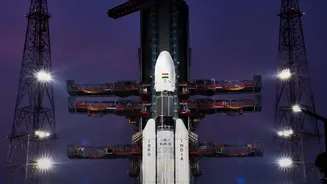
Perched atop the Gaganyaan crew module is the escape tower, a lattice-like structure packed with powerful, quick-acting solid rocket motors. ISRO's design uses a 'puller' configuration, similar to the systems on the Apollo and Soyuz rockets, where the tower literally pulls the capsule clear. This system includes several distinct motors, each with a specific job. High-altitude and low-altitude escape motors provide the raw power needed to accelerate the crew module away from the main rocket stack. In fact, the CES is designed to generate an acceleration up to 10 times that of gravity, ensuring it can outpace a malfunctioning launch vehicle. Pitch motors help steer the capsule, while a jettison motor fires later to discard the escape tower once its job is done, allowing the capsule to deploy its parachutes.
A Symphony of Fire and Precision
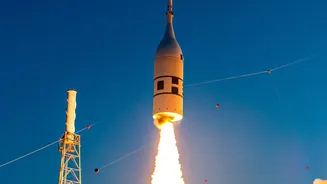
The entire abort sequence is a high-speed, automated symphony of precision engineering. The launch vehicle’s health is continuously monitored by an onboard computer system. If this system detects a critical anomaly, it can trigger the abort sequence automatically. First, explosive bolts sever the connection between the crew module and the rocket. Simultaneously, the escape motors ignite, unleashing immense thrust to pull the capsule up and away. The escape tower's motors burn for only a few seconds, but that's enough to carry the crew module to a safe altitude. Once the capsule reaches the peak of its emergency trajectory, the escape tower is jettisoned. From there, a carefully choreographed sequence of parachutes—starting with smaller drogue chutes to stabilise and slow the module, followed by massive main parachutes—deploys to ensure a gentle splashdown in the ocean.
ISRO’s Rigorous Path to Perfection
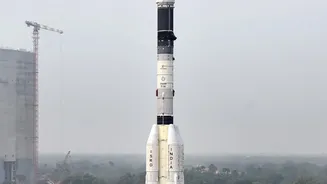
An escape system is only as good as its testing. ISRO has been conducting a series of exhaustive tests to validate every component and scenario. A key milestone was the Pad Abort Test (PAT) in 2018, which successfully demonstrated the system's ability to save a crew even if an emergency occurs on the launchpad before liftoff. More recently, the Test Vehicle Abort Mission-1 (TV-D1) in October 2023 was a landmark success. In this test, a dedicated vehicle was launched to an altitude of about 17 km and a speed of Mach 1.2 (faster than sound), where an in-flight abort was deliberately triggered. The CES performed perfectly, pulling the uncrewed module away from the rocket and allowing it to splash down safely in the Bay of Bengal, where it was recovered by the Indian Navy. Throughout 2026, further tests, including Integrated Air Drop Tests using Air Force helicopters, have successfully validated the parachute systems, a crucial part of the post-abort sequence.
The Final Leg Before Human Flight
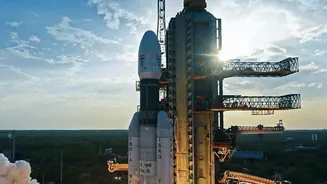
With thousands of tests completed, ISRO is now in the final leg of preparations for the first uncrewed Gaganyaan mission, expected in late 2026 or early 2027. This flight, featuring the humanoid robot Vyommitra, will be a full dress rehearsal, testing not just the launch vehicle but all life support and safety systems in space. The successful validation of the Crew Escape System is a testament to ISRO's unwavering commitment to astronaut safety. It’s a powerful symbol that before India sends its citizens to the stars, it has first mastered the technology to bring them back safely, no matter what happens on the perilous climb to orbit.