




The Moon's Hidden Sanctuaries
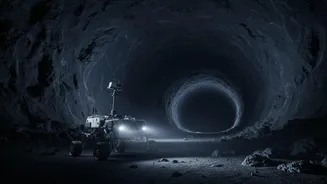
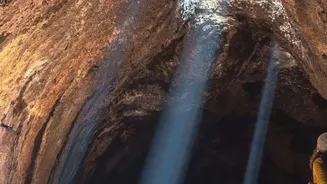
Billions of years ago, when the Moon was volcanically active, rivers of lava flowed across its surface. As the top layer of these flows cooled and hardened, the molten rock underneath continued to move, eventually draining away to leave behind vast, hollow
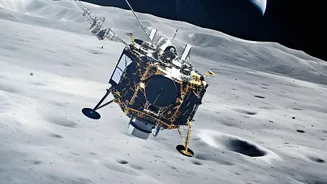
tunnels. These formations, known as lava tubes, are now a major focus for scientists and space agencies. Some are thought to be colossal, with diameters of hundreds of meters, potentially large enough to house entire cities. Their existence was first suggested by observations of 'skylights'—collapsed sections of a tube's roof—by Japan's KAGUYA orbiter in 2009. Since then, radar data has helped confirm that these pits often lead into extensive cave networks. These subterranean voids are not just geological curiosities; they represent the most promising solution to one of the biggest challenges of lunar colonisation: survival.
A Surface Fraught with Danger
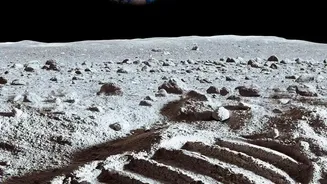
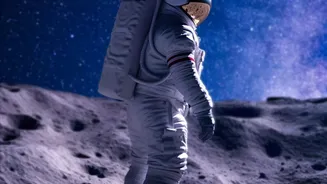
The lunar surface is an incredibly hostile environment. With no atmosphere to act as a shield, it is constantly bombarded by cosmic radiation and solar particle events, which pose a significant threat to human health. It is also pelted by micrometeorites traveling at immense speeds. Furthermore, temperatures swing wildly, from a scorching 120°C in sunlight to a frigid -130°C in the lunar night. Building a surface habitat capable of protecting astronauts from these hazards would be a monumental engineering feat, requiring massive amounts of shielding. Lava tubes, however, offer a natural solution. Buried under meters of solid basaltic rock, they provide excellent protection from radiation, meteorites, and temperature extremes. Some studies suggest the temperature inside these tubes remains at a stable, almost comfortable, 17°C.
Robots to the Rescue
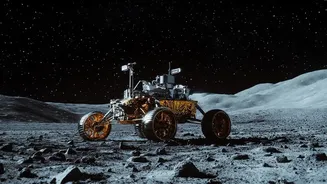
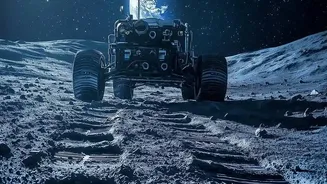
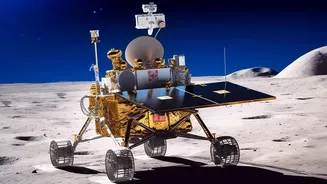
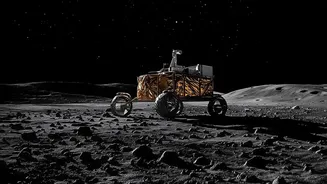
Before astronauts can move in, these caves must be explored. Sending humans into these unknown, dark, and potentially treacherous tunnels is too risky. This is a job for robots. Multiple space agencies and private companies are developing innovative robotic systems designed specifically for this task. The European Space Agency (ESA) has been studying concepts like Daedalus, a spherical probe that would be lowered into a pit on a tether to create 3D maps. Other concepts involve teams of autonomous robots. For example, the CoRob-X project, tested in volcanic caves on Earth, uses a trio of robots: one maps the surface, one lowers a scout into the cave, and the scout explores and maps the interior. To solve the problem of power and communication in a GPS-denied environment, some teams are exploring wireless power transfer, while others, like Austin-based Stone Aerospace, recently received NASA funding to develop a laser-powered drone. This drone, the Lunar Underground eXplorer (LUX), would be tethered to a surface rover by a fiber-optic cable that provides power, data transmission, and even thrust.
Blueprints for a Subterranean Future
The data sent back by these robotic pioneers will inform the design of future lunar habitats. Researchers are already conceptualizing what these underground bases might look like. Designs from the University of Arizona's SpaceTREx lab include plans for a lunar command center, data storage facilities, and an emergency astronaut refuge stocked with months of supplies. The natural insulation of the caves would drastically reduce the energy needed for temperature regulation. Rather than shipping heavy structures from Earth, future missions will likely rely on in-situ resource utilization (ISRU), using lunar regolith (soil) to 3D-print bricks and other construction components. The lava tubes would serve as a pre-built, protective shell into which inflatable habitats or locally constructed modules could be placed, creating a safe and stable environment for long-term human settlement.